
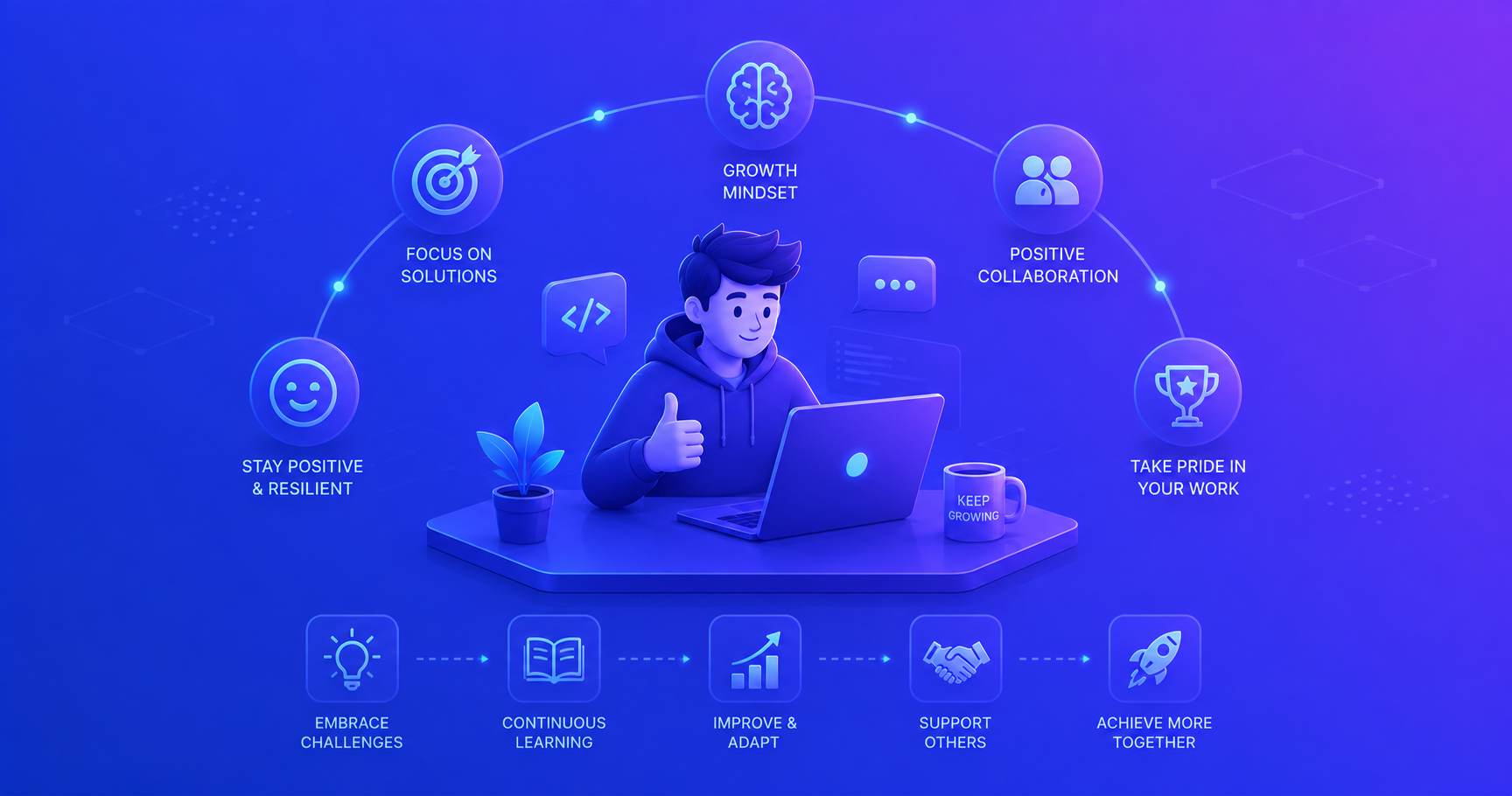
This post is part of our Soft Skills series for software engineers. To learn more about self-management fundamentals, check out our post on Self-Management first!
What Is a Positive Work Attitude?
When you hear “positive work attitude,” you might think it means being cheerful all the time or never complaining. But it’s much more nuanced than that. A positive work attitude is a professional mindset that approaches challenges, setbacks, and learning opportunities with constructive thinking and resilience.
For software engineers, especially those early in their career, attitude can be the difference between rapid growth and stagnation. It’s about how you respond when your code doesn’t compile, when a code review comes back with ten comments, or when you’re assigned to debug legacy code you’ve never seen before.
The Growth Mindset Foundation
At the core of a positive work attitude is what psychologist Carol Dweck calls a growth mindset, the belief that abilities and intelligence can be developed through dedication and hard work. This contrasts with a fixed mindset, which assumes talents are innate and unchangeable.
Growth Mindset vs Fixed Mindset
Understanding the fundamental difference.
Growth Mindset:
- Views challenges as opportunities to learn
- Embraces feedback as a tool for improvement
- Persists through difficulties
- Learns from criticism and setbacks
- Finds inspiration in others’ success
Fixed Mindset:
- Avoids challenges to prevent failure
- Ignores or rejects feedback
- Gives up easily when facing obstacles
- Takes criticism personally
- Feels threatened by others’ success
In software engineering, a growth mindset means seeing every bug as a learning opportunity, every code review as a chance to improve, and every new technology as an exciting challenge rather than an intimidating obstacle.
flowchart TB
    subgraph Growth["Growth Mindset Path"]
        direction TB
        G1[Challenge Encountered]
        G2[View as Learning Opportunity]
        G3[Apply Effort & Strategy]
        G4[Learn from Feedback]
        G5[Improve Skills]
        G6[Greater Success]

        G1 --> G2 --> G3 --> G4 --> G5 --> G6
        G6 -.->|Confidence Builds| G1
    end

    subgraph Fixed["Fixed Mindset Path"]
        direction TB
        F1[Challenge Encountered]
        F2[View as Threat]
        F3[Avoid or Give Up]
        F4[Reject Feedback]
        F5[Skills Stagnate]
        F6[Limited Success]

        F1 --> F2 --> F3 --> F4 --> F5 --> F6
        F6 -.->|Fear Reinforced| F1
    end

    Start[New Junior Developer] --> Growth
    Start --> Fixed

    style Growth fill:#d4edda
    style Fixed fill:#f8d7da
Why Attitude Matters More Than You Think
As a junior developer, you might believe that technical skills are the only thing that matters. While technical competence is crucial, your attitude significantly impacts your career trajectory in ways that aren’t immediately obvious.
Impact on Learning Velocity
Your attitude directly affects how quickly you learn and adapt. Consider these two scenarios:
Developer A (Positive Attitude):
1
2
3
4
5
6
7
8
9
10
11
12
13
14
// Encounters an error in the code
NullPointerException at line 42

// Response: "Interesting! Let me understand why this is null."
// Debugs systematically, learns about null safety
// Applies defensive programming techniques

public String getUserName(User user) {
    // Added null check after learning from the error
    if (user == null) {
        return "Guest";
    }
    return user.getName();
}
Developer B (Negative Attitude):
1
2
3
4
5
6
7
8
9
10
11
12
13
14
15
// Encounters the same error
NullPointerException at line 42

// Response: "This language is terrible! Why doesn't it just work?"
// Adds a quick fix without understanding the root cause
// Same type of bug appears repeatedly

public String getUserName(User user) {
    // Quick fix without understanding
    try {
        return user.getName();
    } catch (Exception e) {
        return "Guest";
    }
}
Developer A transforms the error into a learning opportunity, while Developer B misses the chance to grow. Over time, these small differences compound into significant skill gaps.
The Ripple Effect on Team Dynamics
Software engineering is inherently collaborative. Your attitude doesn’t just affect you, it influences your entire team.
| Positive Attitude Behaviors | Impact on Team | Negative Attitude Behaviors | Impact on Team |
|---|---|---|---|
| Asks thoughtful questions | Encourages knowledge sharing | Complains about unclear requirements | Creates defensive atmosphere |
| Offers to help teammates | Builds trust and collaboration | Only focuses on own tasks | Reduces team cohesion |
| Thanks reviewers for feedback | Makes code review constructive | Argues defensively about every comment | Discourages thorough reviews |
| Shares learnings from mistakes | Prevents team-wide issues | Hides mistakes or blames tools | Others repeat same mistakes |
| Celebrates team wins | Boosts morale | Takes credit or stays silent | Reduces motivation |
According to research cited by InspireZone Tech, attitude plays a crucial role in determining success for aspiring software engineers, often outweighing pure technical ability in team environments.
Career Progression and Opportunities
graph LR
    subgraph Career Impact
        direction TB
        PA[Positive Attitude]

        PA --> L[Faster Learning]
        PA --> T[Better Team Relations]
        PA --> R[Constructive Code Reviews]
        PA --> M[Stronger Mentorship]

        L --> O[More Opportunities]
        T --> O
        R --> O
        M --> O

        O --> P[Career Growth]
        O --> LE[Leadership Roles]
        O --> ME[Mentorship Opportunities]
    end

    style PA fill:#90EE90
    style O fill:#FFD700
    style P fill:#87CEEB
When senior engineers and managers notice your positive attitude, you become their first choice for:
- Challenging projects that stretch your abilities
- Cross-team collaborations that expand your network
- Mentorship opportunities that accelerate your growth
- Promotion considerations when positions open up
Maintaining Positivity During Debugging Sessions
Debugging is where attitude is tested most frequently. A bug that takes hours or days to resolve can be frustrating, but your response determines whether it becomes a growth experience or a source of burnout.
The Debugging Mindset Shift
Reframing Debugging
Turn frustration into fascination.
Instead of viewing debugging as a frustrating interruption, reframe it as:
- A Mystery to Solve - You’re a detective following clues
- A Learning Opportunity - Each bug teaches you something about the system
- A Chance to Improve - Finding bugs before production is a win
- A Skill Builder - Debugging makes you a better developer
Practical Example:
1
2
3
4
5
6
7
8
9
10
11
12
13
14
15
16
17
18
19
20
21
22
// Bug: User list not displaying in the UI
public List<User> getActiveUsers() {
    List<User> users = userRepository.findAll();
    users.removeIf(user -> !user.isActive());
    return users;
}

// Instead of: "Why isn't this working? This should work!"
// Think: "Interesting! The logic looks right. Let me trace the data flow."

// Through debugging, you discover the issue:
// The repository is returning an unmodifiable list!

// Learning: Some collections are immutable
// Solution:
public List<User> getActiveUsers() {
    List<User> users = userRepository.findAll();
    // Create a new mutable list
    return users.stream()
               .filter(User::isActive)
               .collect(Collectors.toList());
}
What You Learned:
- Java collection mutability concepts
- Stream API usage
- Defensive programming practices
- Repository pattern nuances
This single debugging session added four new concepts to your knowledge base!
The Debugging Cycle with Positive Attitude
stateDiagram-v2
    [*] --> EncounterBug
    EncounterBug --> StayCalm: Take a breath
    StayCalm --> Understand: "What is actually happening?"
    Understand --> Hypothesize: "Why might this occur?"
    Hypothesize --> Test: "Let me verify my theory"
    Test --> Fixed: Hypothesis correct
    Test --> Understand: Hypothesis incorrect
    Fixed --> Document: "What did I learn?"
    Document --> Share: "How can I help others?"
    Share --> [*]

    note right of StayCalm
        Positive attitude checkpoint:
        "This is solvable"
    end note

    note right of Understand
        Curiosity over frustration:
        "This is interesting"
    end note

    note right of Document
        Growth mindset:
        "I'm better for this"
    end note
Practical Debugging Strategies
- The Rubber Duck Technique
- Explain the problem out loud (to a rubber duck, colleague, or yourself)
- Often, articulating the issue reveals the solution
- Maintains positive energy by making debugging interactive
- The Fresh Eyes Approach
- After 30 minutes stuck, take a 5-minute break
- Walk away from your desk, grab water, stretch
- Return with renewed perspective
- The Learning Log ```java /*
- Bug Fixed: NullPointerException in getUserProfile()
- Date: 2026-01-04
- Root Cause: User object from cache could be null after expiry
- Solution: Added null check and cache refresh logic
- Learned: Always validate cached data assumptions
- Prevention: Added unit tests for cache expiry scenarios */ ```
Pro Tip: Keep a “wins journal” where you record bugs you’ve solved. When you’re frustrated, review it to remind yourself of your problem-solving capabilities.
Thriving in Code Reviews
Code reviews are one of the most valuable learning opportunities for junior developers, and one of the most challenging for maintaining a positive attitude. Receiving criticism about your code can feel personal, but it’s an essential part of growth.
Reframing Code Review Feedback
Code Review Mindset
How to view feedback constructively.
Instead of thinking:
- “They’re criticizing me” → Think: “They’re helping me improve”
- “They think I’m incompetent” → Think: “They care about code quality and my growth”
- “I should have known better” → Think: “Now I know for next time”
- “This is embarrassing” → Think: “Every senior developer has been here”
Practical Response Examples:
❌ Defensive Response:
1
2
Reviewer: "This method is doing too much. Consider breaking it into smaller functions."
You: "But it works fine. I don't see why we need to change it."
✅ Positive Response:
1
2
3
4
Reviewer: "This method is doing too much. Consider breaking it into smaller functions."
You: "Good point! I can see how it would be more maintainable.
     Would you recommend extracting the validation logic first,
     or should I split it differently?"
The positive response:
- Acknowledges the feedback
- Shows willingness to learn
- Asks clarifying questions
- Invites collaboration
The Code Review Growth Cycle
sequenceDiagram
    participant Dev as Junior Developer
    participant Rev as Reviewer
    participant Code as Code Quality
    participant Skill as Your Skills

    Dev->>Rev: Submit pull request
    Rev->>Dev: Provides feedback

    alt Positive Attitude
        Dev->>Dev: "Opportunity to learn!"
        Dev->>Rev: Ask clarifying questions
        Rev->>Dev: Explains reasoning
        Dev->>Code: Improve code
        Code->>Skill: Knowledge gained
        Skill->>Dev: Better future code
        Dev->>Rev: Thank reviewer
        Note over Dev,Rev: Trust builds
    else Negative Attitude
        Dev->>Dev: "They're picking on me"
        Dev->>Rev: Defensive response
        Rev->>Dev: Frustrated explanation
        Dev->>Code: Minimal changes
        Code->>Skill: Limited learning
        Note over Dev,Rev: Tension builds
    end
Code Review Best Practices for Positivity
1. Thank Your Reviewers
1
2
3
4
5
6
7
8
9
10
11
12
// Before submitting your PR, add a thoughtful description
/**
 * PR Description:
 * Implements user authentication feature
 *
 * Notes for reviewers:
 * - First time implementing JWT, feedback welcome on security approach
 * - Not sure if error handling in UserService is sufficient
 * - Open to suggestions on test coverage
 *
 * Thank you for taking time to review! 🙏
 */
2. Respond Promptly and Positively
1
2
3
4
5
6
7
Reviewer: "Consider using Optional<User> instead of returning null"

Your response:
"Great suggestion! I didn't know about Optional. I've updated the code
and added some tests. Could you verify this is what you had in mind?"

Commit: "refactor: Use Optional<User> per review feedback"
3. Ask for Learning, Not Just Approval
1
2
3
4
5
In your PR description:
"I'd especially appreciate feedback on:
1. My approach to error handling (lines 45-67)
2. Whether these test cases cover the edge cases
3. Any design patterns I should consider here"
Remember: Every comment on your code is someone investing their time in making you better. That’s a gift.
Daily Habits for Maintaining Positivity
Maintaining a positive work attitude isn’t about forcing yourself to be happy, it’s about building sustainable habits that support resilient thinking.
Morning Rituals for a Positive Start
The 3-2-1 Morning Routine
Start your day with intention.
3 Things to Review:
- Your main task for the day
- One thing you learned yesterday
- One person you can help today
2 Minutes of Preparation:
- Clear your workspace (physical and digital)
- Open only necessary tools/tabs
1 Positive Affirmation:
- “I am capable of learning what I don’t know”
- “Challenges help me grow”
- “I bring value to my team”
Implementation Example:
1
2
3
4
5
6
7
8
9
10
11
12
13
14
15
16
// Create a daily standup notes file
/**
 * Daily Standup - 2026-01-04
 *
 * Today's Focus:
 * - Complete user authentication feature
 *
 * Yesterday's Learning:
 * - Learned about Optional<T> for null safety
 *
 * How I Can Help:
 * - Offer to pair program with Sarah on the API endpoint
 *
 * Mindset:
 * - Challenges help me grow
 */
Throughout the Day
1. The “3 Positives” Practice
Before logging off, write down three positive things from your day:
1
2
3
4
5
6
7
8
9
## End of Day - 2026-01-04

### 3 Positives:
1. Successfully debugged the authentication bug (took 2 hours, but learned about JWT expiration)
2. Received helpful feedback on my PR from Marcus - learned about the Builder pattern
3. Helped Anna understand Git merge conflicts - felt good to give back

### Tomorrow's Opportunity:
- Apply the Builder pattern to my UserService class
2. The Setback Reframe
When something goes wrong, use this mental framework:
| What Happened | Initial Reaction | Reframe | Action |
|---|---|---|---|
| My code caused a production bug | 😰 “I’m terrible at this” | 🤔 “What can I learn to prevent this?” | Study error monitoring, add more tests |
| PR rejected, needs major changes | 😞 “I wasted all that time” | 💡 “I’ll write better code the first time next” | Create a PR checklist for next time |
| Assigned to unfamiliar tech stack | 😟 “I don’t know anything about this” | 🎯 “Chance to expand my skills” | Block learning time, find documentation |
| Teammate found obvious bug I missed | 😣 “How did I miss that?” | ✅ “Good catch! What was I not checking?” | Add this scenario to my review checklist |
3. The Curiosity Habit
Replace frustration triggers with curiosity triggers:
1
2
3
4
5
6
7
8
9
10
11
12
13
14
15
16
17
// When you see code you don't understand
// ❌ Don't think: "This is confusing and poorly written"
// ✅ Think: "I wonder what problem this solves?"

// Example: Encountering a complex generic type
public <T extends Comparable<T>> T findMax(List<T> items) {
    // Instead of being intimidated, think:
    // "What's the benefit of using generics here?"
    // "Why does T need to extend Comparable?"
    // "Let me experiment with this..."

    return items.stream()
               .max(Comparator.naturalOrder())
               .orElseThrow(() -> new IllegalArgumentException("Empty list"));
}

// Research it, understand it, then you own it!
Weekly Reflection
Every Friday, take 15 minutes for reflection:
Weekly Attitude Audit
Check your mindset health.
Questions to ask yourself:
- Learning: What’s the most interesting thing I learned this week?
- Challenges: What frustrated me? How did I respond?
- Relationships: Did I support my teammates? Did I accept support?
- Growth: What would I do differently next week?
- Gratitude: What am I grateful for in my work?
Example Entry:
1
2
3
4
5
6
7
8
9
10
11
12
13
14
15
16
17
18
19
20
21
22
23
24
25
## Week of 2026-01-04

### Learning
- Discovered the power of Optional<T> for null safety
- Learned about JWT token expiration handling

### Challenges
- Spent 3 hours debugging NullPointerException
- Initially frustrated, but took a break and came back fresh
- Fixed it and learned about defensive programming

### Relationships
- Got great feedback from Marcus on my PR
- Helped Anna with Git - felt good to contribute
- Need to ask more questions in team meetings

### Growth
- Next week: Apply Builder pattern I learned
- Start using Optional in my new code
- Be more proactive in standup discussions

### Gratitude
- Grateful for patient code reviewers
- Lucky to have challenging problems to solve
- Appreciate that I'm paid to learn
Real-World Scenarios: Attitude in Action
Let’s explore how a positive work attitude plays out in common situations junior developers face.
Scenario 1: The Overwhelming Feature
Situation: You’re assigned a feature that seems far beyond your current abilities.
1
2
3
4
5
6
7
8
9
10
11
12
13
14
15
16
17
18
19
20
21
22
23
24
25
26
27
28
29
30
31
32
33
34
35
36
// Task: Implement a caching layer with Redis for the entire user service
// Your experience: You've barely heard of Redis

// ❌ Negative Attitude Approach
"I can't do this. They should have given this to a senior developer.
I'm going to fail and everyone will see I don't belong here."
// Result: Anxiety, procrastination, asking for reassignment

// ✅ Positive Attitude Approach
"This is a stretch, but it's an opportunity to level up.
Let me break this down and ask for guidance on the approach."

// Action Plan:
/**
 * Feature: User Service Caching Layer
 *
 * My Strategy:
 * 1. Research Phase (Day 1)
 *    - Read Redis documentation
 *    - Find examples in our codebase
 *    - Look for similar implementations online
 *
 * 2. Design Phase (Day 2)
 *    - Sketch out approach
 *    - Schedule 30-min review with senior dev
 *    - Ask: "Am I on the right track?"
 *
 * 3. Implementation Phase (Days 3-5)
 *    - Start with simplest use case
 *    - Test incrementally
 *    - Ask questions when stuck
 *
 * 4. Learning Phase (Throughout)
 *    - Document what I learn
 *    - Note what I'd do differently
 */
Outcome: Even if the implementation isn’t perfect, you’ve demonstrated initiative, learning ability, and a positive approach to challenges, qualities that lead to more opportunities.
Scenario 2: The Critical Bug You Caused
Situation: Your code made it to production and caused a bug affecting users.
flowchart TD
    Bug[Bug Discovered in Production]

    Bug --> NegPath[Negative Response]
    Bug --> PosPath[Positive Response]

    NegPath --> N1[Panic and hide]
    NegPath --> N2[Blame the reviewer]
    NegPath --> N3[Make excuses]
    N1 --> NR[Trust damaged]
    N2 --> NR
    N3 --> NR

    PosPath --> P1[Acknowledge immediately]
    PosPath --> P2[Focus on solution]
    PosPath --> P3[Learn and prevent]
    P1 --> PR[Trust maintained]
    P2 --> PR
    P3 --> PR

    PR --> Growth[Career growth]
    NR --> Stagnation[Career stagnation]

    style PosPath fill:#90EE90
    style NegPath fill:#FFB6C6
    style Growth fill:#87CEEB
Positive Response Example:
1
2
3
4
5
6
7
8
9
10
11
12
13
14
15
16
17
18
19
20
21
22
23
24
25
26
27
28
29
30
31
32
33
34
35
36
37
38
// Your message to the team:
"Team, I'm sorry - the authentication bug was caused by my change.
I'm working on a fix now. ETA: 30 minutes.

Root cause: I didn't handle the case where the token is expired but still valid.
Fix: Adding proper expiration validation.
Prevention: Adding integration test for this scenario.

I'll share a post-mortem with learnings after the fix is deployed."

// Later, in the post-mortem:
/**
 * Post-Mortem: Authentication Bug (2026-01-04)
 *
 * What Happened:
 * - Users with expired tokens were still authenticated
 * - Affected ~50 users over 2 hours
 *
 * Root Cause:
 * - My code checked token signature but not expiration
 * - Unit tests didn't cover the expiration scenario
 *
 * Immediate Fix:
 * - Added expiration validation in TokenValidator
 * - Deployed within 30 minutes of discovery
 *
 * Prevention:
 * - Added integration test for expired tokens
 * - Updated PR checklist to include security scenarios
 * - Scheduled pairing session with security team
 *
 * What I Learned:
 * - Always test edge cases, especially for security
 * - Ask for security review on authentication changes
 * - Better to catch in code review than production
 *
 * Thank you to Lisa for catching this quickly!
 */
Why This Works:
- Takes responsibility without making excuses
- Focuses on solution and learning
- Shows maturity and growth mindset
- Builds trust through transparency
Pro Tip: Senior developers remember how you handle failures more than your successes. Taking responsibility and learning from mistakes is a sign of maturity.
Scenario 3: Disagreeing with Technical Decisions
Situation: You disagree with a technical approach your team lead suggests.
❌ Negative Approach:
1
2
"That won't work. We should use [your solution] instead.
I read an article that says this is the right way."
✅ Positive Approach:
1
2
3
4
5
6
7
8
9
"I'm curious about this approach. I've been reading about [alternative],
which might also solve this. Could you help me understand the trade-offs?
I want to learn when to use each approach."

// Follow-up questions that show respect and curiosity:
- "What are the performance implications?"
- "Have we used this pattern elsewhere in the codebase?"
- "Are there scenarios where the alternative might be better?"
- "What would you consider if you were evaluating both options?"
Why This Works:
- Shows respect for experience
- Demonstrates willingness to learn
- Opens dialogue instead of creating conflict
- You might learn why your initial idea wouldn’t work, or you might influence the decision
Building Resilience for Long-Term Positivity
Maintaining a positive attitude isn’t about never feeling frustrated or discouraged, it’s about building resilience to bounce back when you do.
The Resilience Framework
graph TB
    Challenge[Difficult Situation]

    Challenge --> Awareness[Self-Awareness]
    Awareness --> Accept[Accept Your Feelings]
    Accept --> Perspective[Gain Perspective]
    Perspective --> Action[Take Action]
    Action --> Learn[Extract Learning]
    Learn --> Stronger[Stronger for Next Time]

    Stronger -.->|Build Resilience| Challenge

    subgraph Tools
        Support[Peer Support]
        Break[Take Breaks]
        Wins[Remember Past Wins]
        Growth[Growth Mindset]
    end

    Support --> Accept
    Break --> Perspective
    Wins --> Perspective
    Growth --> Action

    style Stronger fill:#90EE90
Practical Resilience Strategies
When You Feel Overwhelmed
Concrete steps to regain balance.
1. The 5-Minute Reset
- Step away from your computer
- Take 5 deep breaths
- Stretch your body
- Drink water
- Write down what’s overwhelming you
2. The Task Breakdown
1
2
3
4
5
6
7
8
9
10
11
12
13
14
15
16
// When a task feels impossible, break it down:

/**
 * Overwhelming Task: Build entire authentication system
 *
 * Breakdown:
 * □ Research existing auth patterns (1 hour)
 * □ Design basic login flow (2 hours)
 * □ Implement user login endpoint (3 hours)
 * □ Add token generation (2 hours)
 * □ Implement token validation (2 hours)
 * □ Add unit tests (3 hours)
 * □ Code review and refinement (2 hours)
 *
 * Total: 15 hours across 3 days = Achievable!
 */
3. The Support Network
- Identify 2-3 colleagues you can ask for help
- Join developer communities (online or local)
- Find a mentor or mentor buddy
- Remember: Asking for help is a strength, not a weakness
Protecting Your Mental Energy
| Energy Drains | Energy Boosters |
|---|---|
| Comparing yourself to senior developers | Comparing yourself to your past self |
| Working in isolation | Regular pair programming |
| Ignoring breaks | Scheduled breaks (Pomodoro technique) |
| Perfectionism on first try | Embracing iteration |
| Saying yes to everything | Setting healthy boundaries |
| Focusing only on what’s wrong | Celebrating small wins |
Warning: Toxic positivity (forcing yourself to be happy all the time) is harmful. It’s okay to feel frustrated, tired, or discouraged. The goal is healthy resilience, not fake cheerfulness.
Measuring Your Attitude Progress
How do you know if you’re developing a more positive work attitude? Look for these indicators:
Short-Term Indicators (Weeks 1-4)
✅ You ask more questions in meetings
✅ You respond to code reviews with curiosity instead of defensiveness
✅ You take breaks when stuck instead of spiraling
✅ You thank colleagues for help and feedback
✅ You notice negative thoughts and can reframe them
Medium-Term Indicators (Months 2-6)
✅ Colleagues seek you out for collaboration
✅ You volunteer for challenging tasks
✅ You recover faster from setbacks
✅ Your code reviews show continuous improvement
✅ You’re mentoring newer developers or teammates
Long-Term Indicators (6+ Months)
✅ You’re assigned to important projects
✅ You’re included in architectural discussions
✅ Your manager mentions your positive impact on the team
✅ You feel excited about Monday mornings (most weeks!)
✅ You can see how far you’ve progressed
Self-Assessment Exercise
Rate yourself honestly (1-5, where 5 is “always” and 1 is “never”):
1
2
3
4
5
6
7
8
9
10
11
12
13
14
15
16
17
18
19
20
21
22
23
24
25
26
27
28
## Positive Work Attitude Self-Assessment

### Learning Mindset
- [ ] I view bugs as learning opportunities (1-5)
- [ ] I seek out challenging tasks (1-5)
- [ ] I ask questions when I don't understand (1-5)

### Collaboration
- [ ] I respond positively to code review feedback (1-5)
- [ ] I offer to help teammates (1-5)
- [ ] I share my learnings with others (1-5)

### Resilience
- [ ] I bounce back quickly from setbacks (1-5)
- [ ] I take breaks when overwhelmed (1-5)
- [ ] I celebrate small wins (1-5)

### Professional Growth
- [ ] I reflect on what I learn weekly (1-5)
- [ ] I thank people who help me (1-5)
- [ ] I maintain work-life balance (1-5)

Score: __/60

15-25: Needs work - Start with one habit from this post
26-40: Good foundation - Focus on consistency
41-50: Strong attitude - Help others develop theirs
51-60: Exceptional - You're a role model for others
Conclusion: Your Attitude Is Your Advantage
As a junior developer, you might feel like you’re behind senior engineers in technical skills, experience, and domain knowledge. And you are, that’s expected and okay. But there’s one area where you can be world-class from day one: your attitude.
A positive work attitude:
- Accelerates your learning by turning every challenge into growth
- Builds your professional network by making you someone people want to work with
- Opens opportunities that aren’t available to more skilled but negative colleagues
- Sustains your career for the long marathon ahead
Remember, every senior developer you admire was once a junior developer who chose to approach challenges with curiosity instead of fear, feedback with openness instead of defensiveness, and setbacks with resilience instead of defeat.
flowchart LR
    subgraph Today
        Junior[Junior Developer]
        Choice{Choose Your Attitude}
        Junior --> Choice
    end

    subgraph Tomorrow
        Positive[Positive Mindset]
        Negative[Negative Mindset]
        Choice --> Positive
        Choice --> Negative
    end

    subgraph Future
        Success[Successful Career<br/>Strong Network<br/>Continuous Growth]
        Struggle[Stagnant Skills<br/>Limited Opportunities<br/>Burnout Risk]

        Positive --> Success
        Negative --> Struggle
    end

    style Positive fill:#90EE90
    style Success fill:#87CEEB
    style Negative fill:#FFB6C6
    style Struggle fill:#FFA07A
Your Next Steps
- This Week:
- Start a “3 positives” daily log
- Respond to one code review with curiosity and gratitude
- Take a proper break when you feel stuck
- This Month:
- Implement the weekly reflection practice
- Share one learning with your team
- Volunteer for one challenging task
- This Quarter:
- Mentor someone newer than you
- Complete the self-assessment and track progress
- Build your resilience toolkit
Remember: You’re not just building software, you’re building a career and a professional identity. A positive work attitude is the foundation for both.
This post was inspired by insights from InspireZone Tech’s article on aspiring software engineers’ success, adapted for our Software Engineering Growth community with practical strategies for junior developers.
What positive attitude practice will you start today? Small changes compound into significant growth. Start with one habit, master it, then add another. Your future self will thank you.