
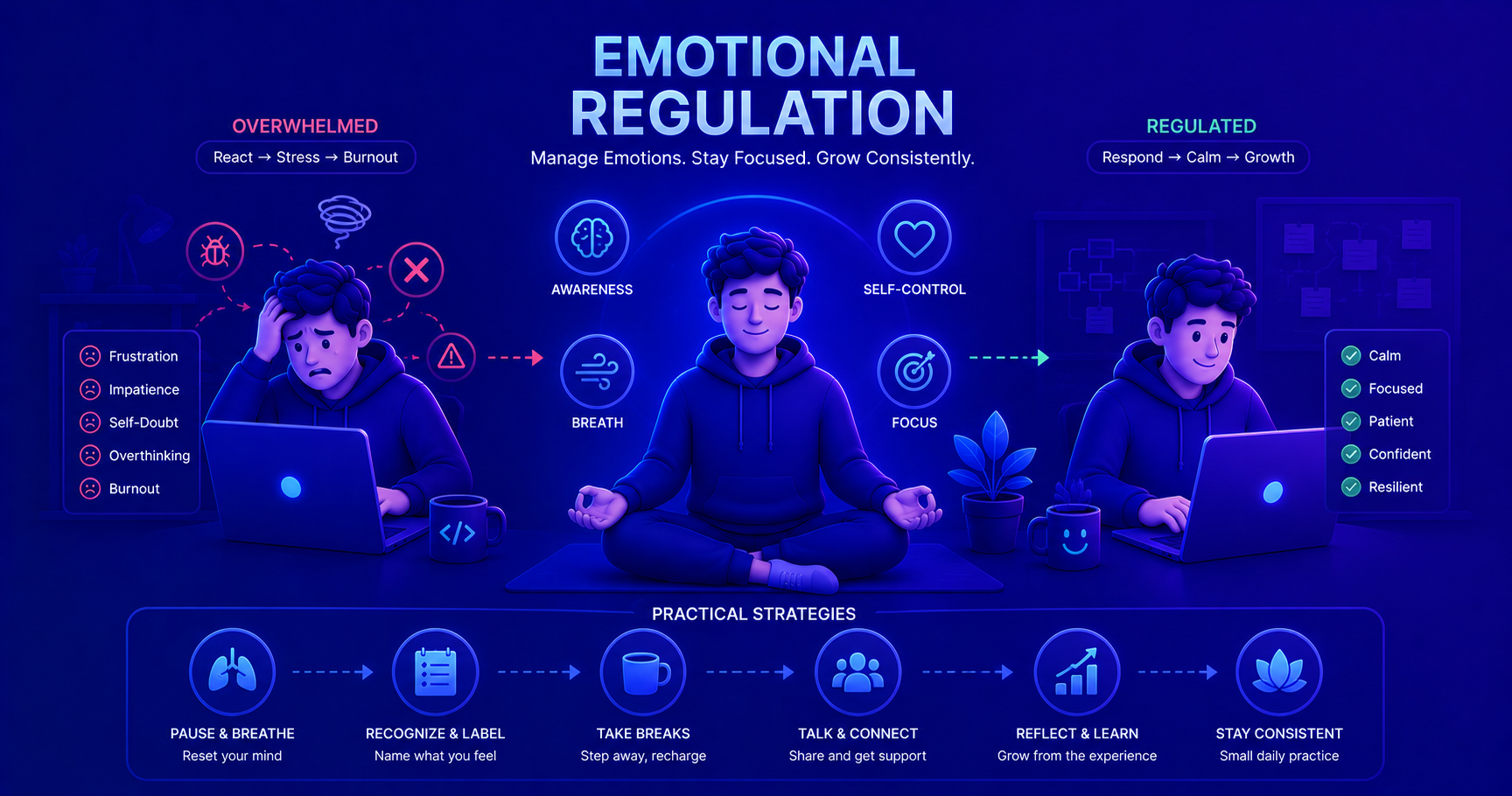
This post explores emotional regulation in software engineering. Mastering this skill is essential for sustainable career growth and maintaining your mental health in a demanding technical field.
What Is Emotional Regulation?
Emotional regulation is the ability to monitor, evaluate, and modify your emotional reactions in response to challenging situations. It’s not about suppressing emotions or pretending problems don’t exist, it’s about responding thoughtfully rather than reacting impulsively.
For software engineers, emotional regulation is particularly crucial. Our work involves:
- Constant problem-solving that can be frustrating when solutions aren’t obvious
- Code reviews that may feel personal but are meant to improve code quality
- Tight deadlines that create pressure and stress
- Complex bugs that can take hours or days to resolve
- Learning new technologies while feeling like everyone else knows more
"I remember spending six hours debugging an issue that turned out to be a single typo. I was so angry at myself that I couldn't focus for the rest of the day. Learning to manage that frustration changed how I approach coding entirely."
Why Emotional Regulation Matters in Software Development
Poor emotional regulation can lead to:
| Impact Area | Consequences |
|---|---|
| Code Quality | Rushing through solutions, skipping tests, creating technical debt |
| Team Dynamics | Defensive reactions to feedback, poor communication, conflicts |
| Decision Making | Choosing quick fixes over proper solutions, abandoning promising approaches too early |
| Career Growth | Avoiding challenges, burnout, missed learning opportunities |
| Mental Health | Chronic stress, anxiety, impostor syndrome, sleep problems |
On the flip side, good emotional regulation helps you:
- Stay focused during long debugging sessions
- Learn from code reviews without taking feedback personally
- Make better technical decisions under pressure
- Build stronger relationships with your team
- Maintain work-life balance and prevent burnout
The Emotional Regulation Process
Understanding how emotional regulation works helps you apply it effectively:
flowchart TB
    A[Trigger Event] --> B[Emotional Response]
    B --> C{Awareness}
    C -->|Unaware| D[Automatic Reaction]
    C -->|Aware| E[Pause & Assess]
    E --> F[Choose Response]
    F --> G[Regulated Action]
    D --> H[Potential Negative<br/>Consequences]
    G --> I[Positive Outcome]

    style C fill:#4CAF50,color:#fff
    style E fill:#2196F3,color:#fff
    style F fill:#2196F3,color:#fff
    style G fill:#4CAF50,color:#fff
    style H fill:#f44336,color:#fff
    style I fill:#4CAF50,color:#fff
The key is building awareness between the emotional response and your action. This creates space for choice.
Common Emotional Triggers for Junior Developers
Understanding your triggers is the first step toward managing them effectively:
mindmap
  root((Emotional<br/>Triggers))
    Technical Challenges
      Bugs that won't resolve
      Unclear error messages
      Breaking production
      Technology overwhelm
    Social Situations
      Code review feedback
      Asking for help repeatedly
      Comparing to senior devs
      Impostor syndrome
    Work Environment
      Tight deadlines
      Changing requirements
      Interruptions
      Unclear expectations
    Personal Factors
      Fatigue and burnout
      Life stress spillover
      Perfectionism
      Fear of failure
Scenario: The Endless Bug Hunt
Trigger: You’ve been debugging for three hours with no progress. Your teammates seem to solve problems effortlessly.
Common Emotional Responses:
- Frustration and anger at yourself
- Anxiety about wasting time
- Shame about needing help
- Impostor syndrome thoughts (“I don’t belong here”)
Unregulated Reaction: Frantically trying random solutions, snapping at colleagues who interrupt, or giving up entirely.
Regulated Response: Taking a break, explaining the problem to a rubber duck (or colleague), breaking the problem into smaller pieces, or asking for help without self-judgment.
Scenario: Critical Code Review Feedback
Trigger: A senior developer points out multiple issues in your pull request.
Common Emotional Responses:
- Defensiveness and wounded pride
- Embarrassment and shame
- Self-doubt about your abilities
- Anxiety about job security
Unregulated Reaction: Arguing about the feedback, making minimal changes without understanding, or avoiding future pull requests.
Regulated Response: Asking clarifying questions, viewing feedback as learning opportunities, thanking the reviewer, and implementing changes thoughtfully.
Remember: Code reviews critique the code, not you as a person. Even senior developers receive feedback, it’s how we all improve.
Practical Techniques for Managing Emotions
1. The STOP Technique
When you notice strong emotions arising, use this four-step process:
STOP
A simple but powerful technique for emotional regulation.
- S - Stop: Pause what you’re doing. Step away from the keyboard if needed.
- T - Take a breath: Deep breathing activates your parasympathetic nervous system, reducing stress.
- O - Observe: Notice your thoughts, feelings, and physical sensations without judgment.
- P - Proceed: Choose a mindful response based on your values and goals.
Example: Your code breaks production. Before panicking:
- Stop typing and close Slack
- Take three deep breaths
- Observe the panic, racing heart, catastrophic thoughts
- Proceed by calmly checking logs and following the incident response process
2. Cognitive Reframing
Reframing changes how you interpret situations, which changes your emotional response:
| Unhelpful Thought | Reframed Thought |
|---|---|
| “This bug is impossible to fix” | “This bug is challenging, but every bug has a cause” |
| “I’m the worst developer here” | “I’m learning, and everyone started somewhere” |
| “I should know this already” | “This is new to me, and it’s okay to learn” |
| “This code review means I’m terrible” | “This feedback will make me a better developer” |
| “I can’t ask for help again” | “Asking questions is how I grow faster” |
How to Practice Reframing
Daily exercise for building this skill.
- Notice an unhelpful thought pattern
- Question it: “Is this thought true? What evidence do I have?”
- Generate alternative interpretations
- Choose a more balanced perspective
- Act based on the reframed thought
Practice this during calm moments so it becomes automatic during stress.
3. The 90-Second Rule
Neuroanatomist Dr. Jill Bolte Taylor discovered that an emotion’s chemical response lasts about 90 seconds. After that, you’re choosing to continue the emotional response.
Application in coding:
- When frustration hits, set a 90-second timer
- Breathe and observe the physical sensations
- Notice how the intensity naturally decreases
- Resume work with a clearer mind
The 90-second rule doesn’t mean emotions disappear, it means the initial automatic response passes quickly if you don’t fuel it with rumination.
4. Strategic Breaks and Movement
Physical movement helps regulate emotions by:
- Reducing stress hormones (cortisol)
- Increasing mood-boosting endorphins
- Breaking rumination cycles
- Resetting your focus
Break Strategies for Developers
When and how to step away effectively.
Micro-breaks (2-5 minutes):
- Stretch at your desk
- Walk to get water
- Look out a window (reduce eye strain + mental break)
- Do 10 jumping jacks or push-ups
Standard breaks (10-15 minutes):
- Walk outside
- Chat with a colleague about non-work topics
- Practice a quick meditation
- Eat a healthy snack
When to take breaks:
- After 90 minutes of focused work (Ultradian rhythm)
- When frustration builds during debugging
- Before responding to challenging feedback
- When you catch yourself in negative thought loops
Pro tip: Use the Pomodoro Technique, 25 minutes of focused work, 5-minute break. This prevents emotional buildup.
5. Rubber Duck Debugging (With Emotional Benefits)
Explaining your problem out loud to an inanimate object (or patient colleague) serves two purposes:
Technical: Often reveals the solution as you articulate the problem
Emotional:
- Externalizes the problem, making it less overwhelming
- Slows your thinking from panic mode to analytical mode
- Creates psychological distance from the frustration
1
2
3
4
5
6
7
8
9
10
11
12
13
14
15
16
17
18
19
20
21
22
23
24
25
// Illustrative example showing rubber duck debugging in action
class DataProcessingExample {
    private DataObject data;

    // Before rubber ducking: Frustrated, stuck, trying random solutions
    void processDataBroken() {
        try {
            // Why isn't this working?!?!
            data.process(); // Throws NullPointerException
        } catch (Exception e) {
            // Everything I try fails!
            System.err.println("Error: " + e.getMessage());
        }
    }

    // After explaining to rubber duck: "So the data object is null because
    // the initialization happens after... oh! I need to move the initialization up!"
    void processDataFixed() {
        if (data != null) {
            data.process(); // Now it works!
        } else {
            System.out.println("Data not initialized yet");
        }
    }
}
Building Healthy Coping Mechanisms
Not all coping strategies are equal. Some provide short-term relief but long-term harm:
| Unhealthy Coping | Why It’s Harmful | Healthy Alternative |
|---|---|---|
| Working through breaks | Burnout, decreased productivity | Scheduled breaks, Pomodoro Technique |
| Excessive caffeine | Anxiety, sleep issues, crash cycles | Moderate intake, water, exercise |
| Isolation when struggling | Missed learning, longer problem-solving | Asking for help, pair programming |
| Perfectionism | Paralysis, impostor syndrome | Good enough mindset, iteration |
| Comparing to seniors | Demoralization, anxiety | Focus on personal growth trajectory |
| Late-night coding binges | Exhaustion, poor decisions | Consistent schedule, time boundaries |
The Growth Mindset Connection
Your mindset significantly affects emotional regulation:
flowchart LR
    subgraph Fixed["Fixed Mindset"]
        F1[Challenges = Threats]
        F2[Mistakes = Failures]
        F3[Feedback = Criticism]
    end

    subgraph Growth["Growth Mindset"]
        G1[Challenges = Learning]
        G2[Mistakes = Data]
        G3[Feedback = Opportunities]
    end

    Fixed --> |High Stress| E1[Emotional<br/>Dysregulation]
    Growth --> |Lower Stress| E2[Better<br/>Regulation]

    style E1 fill:#f44336,color:#fff
    style E2 fill:#4CAF50,color:#fff
Cultivating a growth mindset:
- View challenges as opportunities to expand your abilities
- Treat mistakes as valuable learning data
- See feedback as investment in your growth
- Celebrate progress, not just perfection
Recognizing and Preventing Burnout
Burnout is the result of chronic emotional and mental stress. Recognizing early signs is crucial:
Warning Signs of Developer Burnout
Physical Signs
Your body’s stress signals.
- Chronic fatigue despite adequate sleep
- Frequent headaches or muscle tension
- Changes in appetite or sleep patterns
- Getting sick more often (weakened immune system)
- Eye strain and physical exhaustion
Emotional Signs
Changes in how you feel.
- Feeling detached or cynical about work
- Loss of motivation or satisfaction in coding
- Increased irritability or mood swings
- Anxiety about work tasks
- Feeling helpless or trapped
Behavioral Signs
Changes in how you work.
- Procrastinating on tasks you used to enjoy
- Decreased productivity despite more hours
- Withdrawing from team activities
- Making more mistakes than usual
- Difficulty concentrating or making decisions
If you recognize multiple burnout signs, take immediate action. Talk to your manager, take time off, or consult a mental health professional. Burnout doesn’t resolve on its own.
Burnout Prevention Strategies
flowchart TB
    subgraph Prevention["Burnout Prevention"]
        B1[Set Boundaries]
        B2[Regular Self-Care]
        B3[Sustainable Pace]
        B4[Social Support]
        B5[Meaningful Work]
    end

    B1 --> |Work hours<br/>Off time| W[Wellbeing]
    B2 --> |Exercise<br/>Hobbies<br/>Sleep| W
    B3 --> |Breaks<br/>Vacation<br/>Recovery| W
    B4 --> |Mentors<br/>Friends<br/>Team| W
    B5 --> |Purpose<br/>Growth<br/>Impact| W

    W --> R[Resilience]

    style W fill:#4CAF50,color:#fff
    style R fill:#2196F3,color:#fff
Practical Prevention:
- Set clear work boundaries: Define work hours and stick to them
- Disconnect regularly: No code or Slack after hours (except on-call)
- Take all vacation days: Rest is not a luxury, it’s necessary
- Maintain non-coding interests: Hobbies provide balance and perspective
- Build support networks: Colleagues, friends, mentors, therapists
- Practice regular self-care: Exercise, sleep, nutrition, social connection
Daily Practices for Emotional Regulation
Building emotional regulation is like building any skill, it requires consistent practice:
Morning Routine (10 minutes)
1
2
3
1. **Check-in** (2 min): How am I feeling? What do I need today?
2. **Set intention** (3 min): What's my focus? How do I want to show up?
3. **Mindful breathing** (5 min): Center yourself before the day begins
During the Workday
- Hourly body scan: Notice tension, adjust posture, breathe
- Emotion labeling: “I’m feeling frustrated” (naming reduces intensity)
- Strategic breaks: Every 90 minutes, step away
- Gratitude moments: Notice what’s going well, not just problems
End-of-Day Reflection (5 minutes)
Evening Wind-Down
Processing the day helps prevent rumination.
- What went well today? (Even small wins count)
- What was challenging? (Without self-judgment)
- What did I learn? (About coding and about myself)
- What will I do differently tomorrow? (One small change)
- What am I letting go of? (Mistakes, stress, perfectionism)
Write these down or discuss with a friend/partner. Externalizing helps closure.
Building a Support System
You don’t have to regulate emotions alone:
| Support Type | How They Help | When to Reach Out |
|---|---|---|
| Mentor | Technical guidance, career perspective | Complex problems, career decisions |
| Peer developers | Shared experiences, mutual support | Daily challenges, learning together |
| Manager | Workload adjustment, resource access | Overwhelming deadlines, team issues |
| Therapist | Professional mental health support | Persistent anxiety, burnout, trauma |
| Friends/family | Emotional support, life balance | General stress, perspective outside work |
Asking for help is not weakness, it’s a professional skill that accelerates your growth and preserves your wellbeing.
Putting It All Together: A Framework for Emotional Resilience
Here’s how to integrate these techniques into your daily work:
flowchart TD
    Start([Start Your Day]) --> Prepare[Morning Preparation]
    Prepare --> |Intention set| Work[Focused Work]

    Work --> Trigger{Emotional<br/>Trigger?}
    Trigger -->|No| Continue[Continue Working]
    Trigger -->|Yes| Notice[Notice & Name Emotion]

    Notice --> Assess{Intensity<br/>High?}
    Assess -->|Low/Medium| Quick[Quick Technique]
    Assess -->|High| Break[Take Break]

    Quick --> |STOP, Reframe| Reset1[Reset]
    Break --> |Walk, Movement| Reset2[Reset]

    Reset1 --> Work
    Reset2 --> Work
    Continue --> Timer{90 min<br/>passed?}
    Timer -->|Yes| ScheduledBreak[Scheduled Break]
    Timer -->|No| Work
    ScheduledBreak --> Work

    Work --> EOD{End of<br/>Day?}
    EOD -->|No| Work
    EOD -->|Yes| Reflect[Evening Reflection]
    Reflect --> Rest[Disconnect & Rest]

    style Notice fill:#FFA726,color:#000
    style Quick fill:#4CAF50,color:#fff
    style Break fill:#2196F3,color:#fff
    style Reflect fill:#9C27B0,color:#fff
Conclusion
Emotional regulation is not about becoming emotionless, it’s about responding wisely to the inevitable challenges of software development. As a junior developer, you’ll face bugs, feedback, deadlines, and self-doubt. How you manage your emotions during these moments determines not just your code quality, but your career satisfaction and longevity.
Key takeaways:
- ✅ Emotional regulation is a learnable skill, not an innate trait
- ✅ Awareness is the first step, notice emotions without judgment
- ✅ Use techniques like STOP, reframing, and strategic breaks
- ✅ Build healthy coping mechanisms and avoid harmful ones
- ✅ Prevent burnout through boundaries, rest, and support
- ✅ Practice daily, emotional regulation improves with consistency
Start small. Choose one technique from this post and practice it for a week. Notice what changes. Then add another. Over time, you’ll build emotional resilience that serves you throughout your entire career.
For deeper exploration of emotional regulation techniques and research, check out BetterUp’s comprehensive guide on emotional regulation skills.
Remember: Taking care of your emotional health isn’t separate from being a good developer, it’s fundamental to it. You’re not just building software; you’re building a sustainable, fulfilling career.
Next Steps:
- Practice the STOP technique during your next frustrating bug
- Schedule regular breaks into your calendar this week
- Identify one person to talk to when you’re struggling
- Start an end-of-day reflection journal
Your future self will thank you for investing in emotional regulation skills today.