
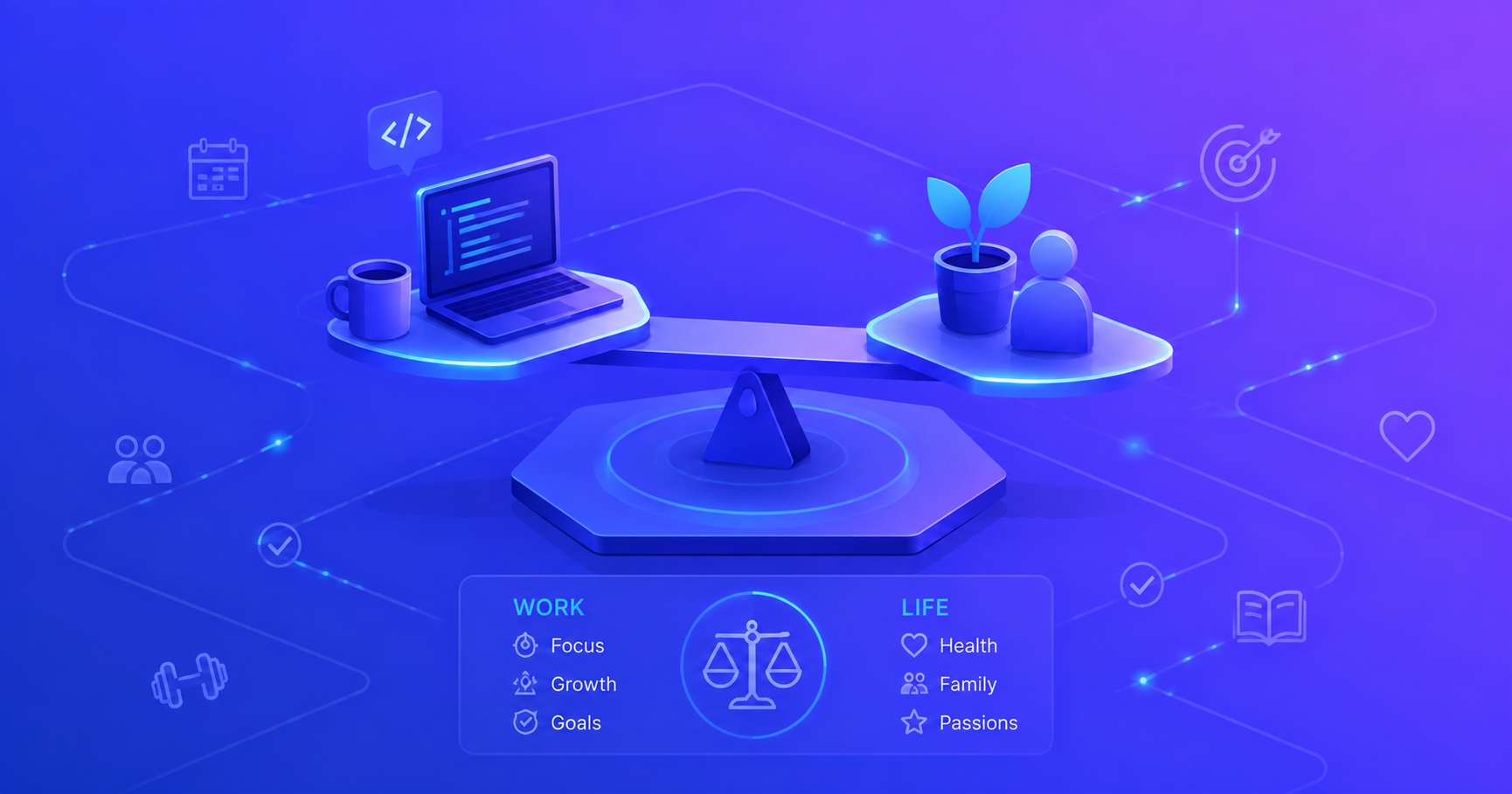
Starting your career as a software engineer? Learning to balance work and personal life from day one is just as important as mastering your first programming language!
What Is Work-Life Balance?
Work-life balance is the equilibrium between your professional responsibilities and your personal life, including family, health, hobbies, and rest. It’s not about splitting your time 50/50 between work and life, but rather about having the flexibility and energy to fulfill both professional and personal commitments without one consistently overwhelming the other.
For junior software engineers, achieving this balance can be particularly challenging. You’re learning new technologies, proving yourself in your first role, and often feeling the pressure to work extra hours to “catch up” with more experienced colleagues.
According to research by MindTools, poor work-life balance can lead to chronic stress, burnout, reduced productivity, and health problems, all of which can derail your promising tech career before it truly begins.
Why Work-Life Balance Matters in Tech
The tech industry is notorious for its demanding culture. Here’s why balance is crucial for junior developers:
- Sustainable Learning: Programming requires mental clarity. Overwork leads to diminished learning capacity
- Creative Problem-Solving: Your best solutions often come when you’re rested and relaxed
- Long-Term Career Growth: Burnout at the junior level can set negative patterns for your entire career
- Code Quality: Exhausted developers write buggy code and miss important details in code reviews
- Team Dynamics: Stressed team members negatively impact collaboration and morale
Signs of Poor Work-Life Balance
Recognizing imbalance early is crucial. Watch for these warning signs:
flowchart TB
    subgraph Physical["Physical Signs"]
        P1[Constant Fatigue]
        P2[Sleep Problems]
        P3[Frequent Illness]
        P4[Eye Strain & Headaches]
    end

    subgraph Mental["Mental/Emotional Signs"]
        M1[Anxiety About Work]
        M2[Reduced Concentration]
        M3[Irritability]
        M4[Loss of Motivation]
    end

    subgraph Behavioral["Behavioral Signs"]
        B1[Working Late Regularly]
        B2[Skipping Breaks/Meals]
        B3[Checking Email 24/7]
        B4[Neglecting Hobbies]
    end

    subgraph Professional["Professional Impact"]
        PR1[Declining Code Quality]
        PR2[Missing Deadlines]
        PR3[Poor Communication]
        PR4[Avoiding Collaboration]
    end

    Physical --> Imbalance[Work-Life Imbalance]
    Mental --> Imbalance
    Behavioral --> Imbalance
    Imbalance --> Professional

    style Imbalance fill:#ff6b6b,stroke:#c92a2a,stroke-width:3px
"In my first job, I thought working until midnight every day would prove I was a dedicated developer. Instead, I burned out within six months and made more bugs than anyone else on the team. I wish someone had told me that sustainability beats intensity every time."
Core Principles of Work-Life Balance
Understanding these foundational principles will guide your approach to balance:
Principle 1: Boundaries Are Professional, Not Selfish
Setting limits protects your performance.
Many junior developers fear that setting boundaries will make them appear uncommitted. The opposite is true: boundaries enable sustainable performance. When you protect your personal time, you return to work refreshed and productive.
Example Boundaries:
- Not checking work email after 7 PM
- Taking full lunch breaks away from your desk
- Using vacation days without guilt
- Saying “no” to non-urgent weekend requests
Principle 2: Quality Over Quantity
Hours worked ≠ value delivered.
A well-rested developer working focused 8-hour days typically produces better code than an exhausted developer working 12-hour days. Focus on impact and quality, not just time spent at your desk.
Practical Application:
- Use time-boxing techniques (Pomodoro)
- Prioritize deep work during your peak energy hours
- Take regular breaks to maintain concentration
- Measure success by delivered features, not hours logged
Principle 3: Prevention Is Easier Than Recovery
Avoid burnout rather than recovering from it.
Burnout recovery can take months or even years. Maintaining balance from the start is exponentially easier than trying to restore it after breaking down.
Prevention Strategies:
- Regular exercise and sleep schedules
- Weekly check-ins with yourself
- Monthly reviews of your work patterns
- Quarterly assessment of your overall satisfaction
Principle 4: Balance Is Dynamic, Not Static
Your needs change with projects and life stages.
Work-life balance isn’t a fixed state. Sometimes you’ll need to invest more in work (product launches, critical bugs), and sometimes you’ll need to prioritize personal matters (family events, health issues). The key is ensuring these are temporary adjustments, not permanent states.
Practical Strategies for Junior Developers
1. Time Management and Boundaries
flowchart LR
    A[Start Your Day] --> B[Check Calendar<br/>& Priorities]
    B --> C[Block Deep Work<br/>Time]
    C --> D[Schedule Breaks]
    D --> E[Set End Time<br/>Alert]
    E --> F[Daily Wrap-Up]
    F --> G[Log Off<br/>Completely]

    style C fill:#51cf66,stroke:#2b8a3e
    style E fill:#ffd43b,stroke:#fab005
    style G fill:#51cf66,stroke:#2b8a3e
Daily Schedule Template for Junior Developers:
| Time | Activity | Balance Strategy |
|---|---|---|
| 9:00 AM | Team standup | Engage fully, then move on |
| 9:30 AM | Deep work block | 90 minutes, no Slack/email |
| 11:00 AM | Break | Walk outside, hydrate |
| 11:15 AM | Code review & collaboration | Help others, ask questions |
| 12:30 PM | Lunch | Away from desk, no work talk |
| 1:30 PM | Learning time | New tech, documentation |
| 3:00 PM | Deep work block | 90 minutes focused coding |
| 4:30 PM | Wrap up & plan tomorrow | Clear tasks, close loops |
| 5:30 PM | Log off | No work devices |
Pro Tip: Use your calendar to block “deep work” time just like you would for meetings. Treat it as non-negotiable.
2. Learning Without Overload
One of the biggest challenges for junior developers is feeling like you need to learn everything immediately. This creates constant anxiety and leads to working nights and weekends.
Healthy Learning Framework:
flowchart TB
    A[Identify Learning Goals] --> B{Is it Required<br/>for Current Job?}
    B -->|Yes| C[Priority 1:<br/>Learn During Work Hours]
    B -->|No| D{Does it Align<br/>with Career Goals?}
    D -->|Yes| E[Priority 2:<br/>Scheduled Personal Time]
    D -->|No| F[Priority 3:<br/>Optional/Future]

    C --> G[Structured Practice]
    E --> H[2-3 Hours/Week Max]
    F --> I[Bookmark for Later]

    G --> J[Track Progress]
    H --> J

    style C fill:#51cf66,stroke:#2b8a3e
    style E fill:#ffd43b,stroke:#fab005
    style F fill:#868e96,stroke:#495057
Learning Boundaries:
1
2
3
4
5
6
7
8
9
10
11
12
13
14
15
16
17
18
19
20
21
22
23
24
// DON'T: Try to learn everything at once
class OverwhelmedDeveloper {
    private void eveningRoutine() {
        learnReact();        // After 8-hour work day
        masterKubernetes();  // Plus this
        studySystemDesign(); // And this
        practiceAlgorithms(); // And this too!
        // Result: Burnout in 2 weeks
    }
}

// DO: Focus on one area at a time
class BalancedDeveloper {
    private String currentFocus = "Spring Boot"; // Job-related
    private int weeklyLearningHours = 3; // Sustainable

    private void eveningRoutine() {
        if (hasEnergyToLearn() && learningHoursThisWeek < weeklyLearningHours) {
            focusedStudySession(currentFocus, 60); // 1 hour max
        } else {
            relaxAndRecharge(); // Equally important!
        }
    }
}
3. Managing Imposter Syndrome and Comparison
Junior developers often sacrifice work-life balance because they’re comparing themselves to senior engineers and trying to close the gap through sheer hours.
| Unhealthy Pattern | Healthy Alternative |
|---|---|
| “Senior devs work late, so I should too” | “I’m learning efficiently during work hours” |
| “Everyone knows more than me” | “I’m growing steadily at my own pace” |
| “I need to prove my worth” | “My contributions have value at my level” |
| “Asking for help shows weakness” | “Asking questions accelerates my learning” |
| “I should know this already” | “Learning is part of being junior” |
Remember: Senior developers have 5-10+ years of experience. Your job isn’t to match their expertise in year one, it’s to grow consistently and sustainably.
4. Communication and Expectation Management
Many balance issues stem from poor communication about workload and capacity.
Effective Communication Strategies:
1
2
3
4
5
6
7
8
9
10
11
12
13
14
15
16
17
18
19
20
21
22
23
24
25
26
27
28
29
30
31
// Scenario: Your manager assigns a new feature on Friday afternoon

// ❌ POOR RESPONSE: Just accept and work all weekend
// Developer says: "Sure, I'll get it done by Monday."
// Result: Working all weekend with no boundaries

// ✅ GOOD RESPONSE: Clarify expectations and boundaries
public class EffectiveCommunication {
    public void handleNewAssignment(Task task) {
        // 1. Acknowledge the request
        System.out.println("Thanks for assigning this feature.");

        // 2. Assess your capacity
        int estimatedHours = estimateWork(task);
        boolean fitsInWorkWeek = canCompleteInWorkHours(estimatedHours);

        // 3. Communicate clearly
        if (fitsInWorkWeek) {
            System.out.println("I can have this ready by Tuesday EOD.");
        } else {
            System.out.println("This looks like 12-15 hours of work. " +
                "Given my current sprint commitments, I can deliver " +
                "this by Thursday. Does that work, or should we " +
                "reprioritize something?");
        }

        // 4. Set boundaries without apologizing
        // Don't say: "Sorry, but I can't work this weekend..."
        // Do say: "I'll start on this Monday morning."
    }
}
How to Say No Professionally
Scripts for common scenarios.
Weekend Work Request:
“I have personal commitments this weekend, but I can prioritize this first thing Monday morning. If it’s truly urgent, let’s discuss which of my current tasks we can postpone.”
After-Hours Meeting:
“I have a commitment at that time. Could we schedule during work hours, or can I contribute asynchronously?”
Scope Creep:
“I want to make sure I deliver quality work. Adding this would push the deadline from Tuesday to Friday. Should we expand the timeline or split this into two separate tasks?”
Learning Pressure:
“I’m currently focused on mastering [current technology]. I’ll add [new technology] to my learning roadmap for next quarter.”
5. Remote Work Boundaries
Remote work blurs the line between office and home, making balance even more challenging for junior developers.
Remote Work Balance Framework:
flowchart TB
    subgraph Physical["Physical Boundaries"]
        PH1[Dedicated Workspace]
        PH2[Work Devices Off After Hours]
        PH3[Separate Work/Personal Devices]
    end

    subgraph Temporal["Time Boundaries"]
        T1[Fixed Start/End Times]
        T2[Scheduled Lunch Away from Desk]
        T3[No Email After Work Hours]
    end

    subgraph Mental["Mental Boundaries"]
        M1[Shutdown Ritual]
        M2[Weekend Screen-Free Time]
        M3[Non-Work Hobbies]
    end

    subgraph Social["Social Boundaries"]
        S1[Clear Availability Hours]
        S2[Camera-Off Breaks]
        S3[Regular In-Person Social Time]
    end

    Physical --> Balance[Healthy Remote<br/>Work-Life Balance]
    Temporal --> Balance
    Mental --> Balance
    Social --> Balance

    Balance --> Outcomes[Better Focus<br/>Reduced Stress<br/>Sustained Performance]

    style Balance fill:#51cf66,stroke:#2b8a3e,stroke-width:3px
Shutdown Ritual Example:
1
2
3
4
5
6
7
8
9
10
11
12
13
14
15
16
17
18
19
20
21
22
23
24
25
26
27
28
29
30
31
32
33
34
public class EndOfDayRitual {
    public void properShutdown() {
        // 1. Review what you accomplished
        logDailyWins();

        // 2. Create tomorrow's priority list (max 3 items)
        planNextDay();

        // 3. Close all work applications
        closeSlack();
        closeIDE();
        closeEmail();

        // 4. Physical transition
        shutDownWorkLaptop();
        leaveWorkspace();

        // 5. Mental transition
        changeClothes();
        physicalActivity(); // Walk, exercise, stretch

        // Now you're truly off work
    }

    private void planNextDay() {
        // Keep it simple: 3 priorities maximum
        List<String> tomorrow = Arrays.asList(
            "Complete user authentication feature",
            "Review Sarah's pull request",
            "Document API endpoints"
        );
        // Don't plan every minute, leave room for the unexpected
    }
}
Common Pitfalls and How to Avoid Them
Pitfall 1: The “Just One More Hour” Trap
The Problem: You tell yourself you’ll work “just one more hour” to finish something, but one hour becomes three, and suddenly it’s 10 PM.
The Solution:
- Set a hard stop time with an alarm
- Use the Zeigarnik Effect to your advantage: write down where you left off, so your brain can let go
- Accept that some tasks will continue tomorrow, that’s normal
1
2
3
4
5
6
7
8
9
10
11
12
13
14
15
16
17
18
19
20
public class TimeManagement {
    private static final LocalTime HARD_STOP = LocalTime.of(17, 30);

    public void workOnFeature() {
        while (!isComplete() && LocalTime.now().isBefore(HARD_STOP)) {
            writeCode();
            runTests();
        }

        if (!isComplete()) {
            // Document stopping point
            writeNotes("Completed: authentication logic. " +
                      "Next: implement token refresh. " +
                      "Blocker: need clarification on expiry time.");

            // Let it go until tomorrow
            closeIDE();
        }
    }
}
Pitfall 2: Guilt About Not Working
The Problem: You feel guilty when you’re not working, constantly thinking “I should be coding” during personal time.
The Solution:
- Recognize rest as productive: your brain consolidates learning during downtime
- Schedule personal time like work commitments
- Track the correlation between rest and code quality
Your value as a developer isn’t measured by hours worked, but by problems solved and value delivered.
Pitfall 3: Skipping Breaks “To Be More Productive”
The Problem: Powering through without breaks to maximize coding time.
The Reality: Research shows productivity drops dramatically after 90 minutes of focused work. Breaks aren’t optional, they’re essential for sustained performance.
Break Schedule:
| Break Type | Frequency | Duration | Activity |
|---|---|---|---|
| Micro-break | Every 25-30 min | 2-3 min | Look away, stretch |
| Short break | Every 90 min | 10-15 min | Walk, water, snack |
| Lunch break | Mid-day | 45-60 min | Away from desk, no screens |
| Exercise break | Daily | 30 min | Physical activity |
Pitfall 4: Always Being Available
The Problem: Responding to Slack messages at all hours to seem responsive and committed.
The Solution:
1
2
3
4
5
6
7
8
9
10
11
12
13
14
15
16
17
18
19
20
21
22
23
public class CommunicationBoundaries {
    // Set clear availability in your Slack status
    private String statusMessage = "🟢 Available 9 AM - 5:30 PM EST | " +
                                   "Will respond to messages next business day";

    // Use Slack's scheduling feature
    public void respondAfterHours(Message msg) {
        if (isUrgentEmergency(msg)) {
            respond(msg); // True emergencies only
        } else {
            scheduleMessage(msg, nextBusinessDay(), LocalTime.of(9, 0));
            // They'll get your response when you're back online
        }
    }

    private boolean isUrgentEmergency(Message msg) {
        // Be honest: how many "emergencies" are actually emergencies?
        // Production down? Yes.
        // Feature request? No.
        // Bug found? Probably can wait until morning.
        return msg.contains("production") && msg.contains("down");
    }
}
Building a Sustainable Career
Work-life balance isn’t just about feeling better in the moment, it’s about building a career that you can sustain and enjoy for decades.
flowchart LR
    A[Year 1-2:<br/>Foundation] --> B[Year 3-5:<br/>Growth]
    B --> C[Year 5+:<br/>Mastery]

    A --> A1[Learn Balance<br/>Early]
    A --> A2[Build Healthy<br/>Habits]

    B --> B1[Sustainable<br/>Learning Pace]
    B --> B2[Quality<br/>Contributions]

    C --> C1[Senior Role with<br/>Low Stress]
    C --> C2[Long, Fulfilling<br/>Career]

    style A1 fill:#51cf66,stroke:#2b8a3e
    style A2 fill:#51cf66,stroke:#2b8a3e
    style C1 fill:#339af0,stroke:#1971c2
    style C2 fill:#339af0,stroke:#1971c2
Monthly Balance Check-In
Set a recurring calendar reminder to assess your balance:
Questions to Ask Yourself:
- Energy Levels: Am I consistently energized, or constantly exhausted?
- Relationships: Am I maintaining connections with friends and family?
- Health: Am I exercising, sleeping well, and eating properly?
- Growth: Am I learning sustainably without overwhelming myself?
- Joy: Do I still enjoy coding, or am I just going through the motions?
- Boundaries: Did I maintain my boundaries this month, or slip into overwork?
If you answer negatively to more than two questions, it’s time to adjust.
When to Seek Help
Sometimes balance issues are symptoms of deeper problems. Seek support if you experience:
- Persistent anxiety or depression
- Physical symptoms (insomnia, digestive issues, chronic pain)
- Thoughts of quitting the industry entirely
- Relationship problems due to work stress
- Substance use to cope with stress
Your company should have an Employee Assistance Program (EAP) offering confidential counseling. Don’t hesitate to use it, taking care of your mental health is as important as any code you’ll write.
Action Plan: Your First 30 Days
Ready to improve your work-life balance? Start here:
Week 1: Assessment
- Track your actual work hours (including evenings/weekends)
- Note energy levels throughout the day
- Identify your biggest balance challenges
Week 2: Boundaries
- Set a fixed end time and stick to it
- Create a shutdown ritual
- Turn off work notifications after hours
Week 3: Communication
- Discuss workload with your manager
- Update your Slack status with availability
- Practice saying “no” to one non-essential request
Week 4: Integration
- Schedule non-negotiable personal time
- Add breaks to your calendar
- Review progress and adjust
1
2
3
4
5
6
7
8
9
10
11
12
13
14
15
16
17
18
public class BalanceJourney {
    // Rome wasn't built in a day, and neither is perfect balance
    public void improveBalance() {
        for (int week = 1; week <= 4; week++) {
            implementOneSmallChange();
            trackProgress();
            adjustAsNeeded();
        }
        // After 30 days, you'll have built a foundation
        // Keep iterating and improving!
    }

    private void implementOneSmallChange() {
        // Don't try to fix everything at once
        // One small, consistent change is better than
        // a dramatic overhaul that you can't sustain
    }
}
Conclusion
Work-life balance isn’t a luxury for junior software engineers, it’s a necessity for building a sustainable, fulfilling career in tech. While the industry can be demanding, you have more control than you think over your time, energy, and boundaries.
Key Takeaways:
- Balance is a skill you develop through practice, not a fixed state you achieve once
- Boundaries are professional, not selfish, they protect your long-term performance
- Quality matters more than quantity, 8 focused hours beat 12 exhausted hours
- Rest is productive, your brain needs downtime to consolidate learning and solve problems
- Communication is crucial, most balance issues can be improved through clear expectations
- Prevention beats recovery, establishing healthy patterns now saves years of burnout
Remember: you’re running a marathon, not a sprint. The developers who thrive long-term aren’t those who work the most hours in their first year, they’re the ones who build sustainable habits that allow them to grow steadily over decades.
Additional resource: For more strategies on achieving work-life balance, check out the comprehensive guide from MindTools.
Now close your laptop, take a break, and remember: your worth as a developer isn’t measured by your last commit, but by the sustainable value you bring to your team and the fulfillment you find in your career and life.