
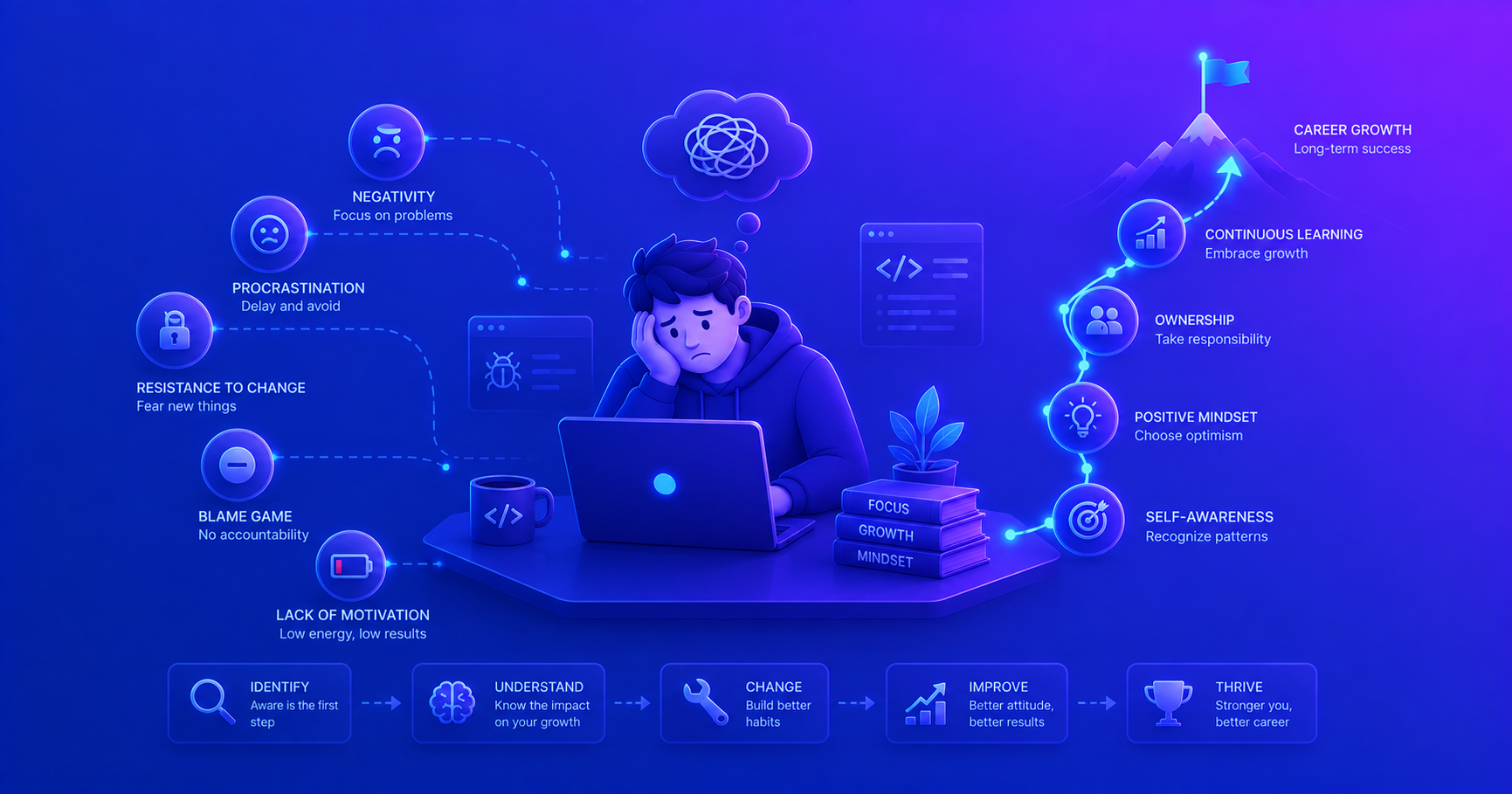
This post explores negative work attitudes and their impact on junior developers. For the positive counterpart, check out our post on Positive Work Attitude to learn how to build a constructive mindset instead!
What Are Negative Work Attitudes?
A negative work attitude is a destructive mindset that prevents professional growth, damages team relationships, and limits career opportunities. Unlike having a bad day or expressing legitimate concerns, negative work attitudes are persistent patterns of thinking and behavior that become defining characteristics of how you approach your work.
For junior software engineers, these attitudes are particularly dangerous because they can become ingrained habits early in your career. What starts as a defensive response to challenges can solidify into character traits that follow you throughout your professional life.
The Cost of Negativity
Consider two developers who joined a company at the same time:
Developer A approaches challenges with curiosity, accepts feedback gracefully, and collaborates openly. After two years, they’re leading small projects and mentoring new hires.
Developer B complains about requirements, argues with code reviewers, and blames tools when things go wrong. After two years, they’re still on the same entry-level tasks, wondering why they’re not advancing.
The technical skills might be similar, but the attitudes created vastly different trajectories.
According to an insightful article on damaging attitudes in software development, certain negative attitudes are particularly toxic in our field and can severely limit professional growth.
flowchart TB
    subgraph Negative["Negative Attitude Cycle"]
        direction TB
        N1[Negative Attitude]
        N2[Avoid Challenges]
        N3[Limited Learning]
        N4[Skill Stagnation]
        N5[Fewer Opportunities]
        N6[Increased Frustration]

        N1 --> N2 --> N3 --> N4 --> N5 --> N6
        N6 -.->|Reinforces| N1
    end

    subgraph Positive["Positive Attitude Cycle"]
        direction TB
        P1[Positive Attitude]
        P2[Embrace Challenges]
        P3[Active Learning]
        P4[Skill Growth]
        P5[More Opportunities]
        P6[Increased Confidence]

        P1 --> P2 --> P3 --> P4 --> P5 --> P6
        P6 -.->|Reinforces| P1
    end

    Choice[Your Choice] --> Negative
    Choice --> Positive

    Negative -.->|Change Mindset| Positive

    style Negative fill:#f8d7da
    style Positive fill:#d4edda
    style Choice fill:#fff3cd
Five Damaging Attitudes in Software Development
Let’s explore the most common negative attitudes that damage junior developer careers, drawing from real-world observations and industry experience.
1. The Blame Shifter: “It’s Not My Fault”
The Blame Shifter
Always finding someone or something else to fault.
What It Looks Like:
- “The requirements were unclear” (instead of asking clarifying questions)
- “The framework is poorly designed” (instead of learning how to use it properly)
- “The previous developer wrote bad code” (instead of improving it)
- “The tests are flaky” (instead of investigating why)
- “My computer is too slow” (instead of optimizing your workflow)
The Impact:
When you shift blame, you surrender control over your own improvement. If problems are always external, you never develop the skills to overcome them.
Real-World Example:
1
2
3
4
5
6
7
8
9
10
11
12
13
14
15
16
17
18
19
20
21
22
23
24
25
26
27
28
// Blame Shifter approach
public void processPayment(Order order) {
    // Code crashes with NullPointerException
    // Response: "The Order class shouldn't allow null values!"
    // "Whoever designed this API is incompetent!"

    PaymentService.process(order.getPaymentDetails());
}

// Growth-Oriented approach
public void processPayment(Order order) {
    // Code crashes with NullPointerException
    // Response: "Let me add defensive checks and understand why this happens"

    if (order == null) {
        throw new IllegalArgumentException("Order cannot be null");
    }

    PaymentDetails details = order.getPaymentDetails();
    if (details == null) {
        throw new IllegalStateException(
            "Order must have payment details before processing"
        );
    }

    PaymentService.process(details);
    // Note: Should also discuss with team about validation at Order creation
}
How It Damages Your Career:
| Short-Term Effect | Long-Term Consequence |
|---|---|
| Team members avoid working with you | Excluded from important projects |
| Managers see you as unreliable | Passed over for promotions |
| You don’t learn from mistakes | Skills stagnate |
| Reputation as “difficult” | Limited networking opportunities |
How to Recognize It in Yourself:
Ask yourself honestly:
- Do I often start explanations with “but…” when things go wrong?
- Do I spend more time explaining why something failed than fixing it?
- Do I feel satisfaction when I can point to an external cause?
- Do I resist taking responsibility for any part of a problem?
Warning: Blame shifting might protect your ego temporarily, but it prevents the learning that comes from owning your mistakes. Every “not my fault” is a missed opportunity for growth.
2. The Perfectionist Paralytic: “It’s Never Good Enough”
The Perfectionist Paralytic
Unable to ship code due to impossible standards.
What It Looks Like:
- Spending days refactoring code that already works
- Refusing to submit pull requests until every edge case is handled
- Rewriting implementations multiple times seeking “the perfect solution”
- Never finishing because there’s always something to improve
- Missing deadlines because “it’s not ready yet”
The Paradox:
While high standards are admirable, perfectionism isn’t about quality, it’s about fear. Fear of judgment, fear of mistakes, fear of criticism.
Real-World Example:
1
2
3
4
5
6
7
8
9
10
11
12
13
14
15
16
17
18
19
20
21
22
23
24
25
26
27
28
29
30
31
32
33
34
35
36
// Perfectionist Paralytic approach - NEVER SHIPS
public class UserValidator {
    // Spent 3 days on this, still not happy with it
    // Hasn't committed because "it could be better"
    // Missed sprint deadline while bikeshedding

    public ValidationResult validate(User user) {
        // Overwrought implementation trying to handle EVERY possible scenario
        // Including ones that will never happen in production
        if (user == null) {
            return ValidationResult.failure("null_user",
                "User object was null, possibly due to database connection failure, " +
                "or incorrect API call, or memory corruption...");
        }
        // 500 more lines of excessive validation...
    }
}

// Pragmatic approach - SHIPS AND ITERATES
public class UserValidator {
    // Good enough for current requirements
    // Can improve based on real usage patterns
    // Shipped on time, team can build on it

    public ValidationResult validate(User user) {
        if (user == null) {
            return ValidationResult.failure("User cannot be null");
        }
        if (user.getEmail() == null || !isValidEmail(user.getEmail())) {
            return ValidationResult.failure("Valid email required");
        }
        return ValidationResult.success();
    }

    // TODO: Add password strength validation in next sprint
}
The Reality Check:
- Shipped code gets feedback; perfect code in your head helps no one
- You learn more from production issues than from endless refinement
- Business value comes from working features, not perfect code
- You can always refactor later based on real needs
How to Recognize It in Yourself:
Ask yourself honestly:
- Do I often say “just one more thing” before submitting work?
- Am I embarrassed to show code that works but isn’t “perfect”?
- Do I rewrite code multiple times without clear improvements?
- Do I miss deadlines regularly because I’m “polishing”?
- Do I feel anxious when I see my code in production?
The Solution:
Adopt the “good enough to ship” mindset:
- Make it work (functional)
- Make it right (clean, maintainable)
- Make it fast (only if needed)
Don’t skip to step 3 when step 1 isn’t done.
Pro Tip: “Perfect is the enemy of good.” Ship working code, gather feedback, iterate. That’s how professional software is built.
3. The Know-It-All: “I Already Know This”
The Know-It-All
Closed to learning and feedback from others.
What It Looks Like:
- Interrupting explanations with “I know, I know”
- Dismissing feedback without consideration
- Skipping documentation because “I can figure it out”
- Not asking questions to avoid appearing ignorant
- Arguing with senior developers about best practices
- Claiming expertise in technologies you’ve barely used
The Irony:
The know-it-all attitude guarantees you’ll learn less than everyone around you. The most experienced developers are often the most curious and open to learning.
Real-World Example:
1
2
3
4
5
6
7
8
9
10
11
12
13
14
15
16
17
18
19
20
21
22
23
24
25
26
27
28
// Know-It-All approach
// Senior dev suggests in code review: "Consider using a Map instead of nested loops"

public User findUserByEmail(List<User> users, String email) {
    // Dismisses feedback: "This is fine, I know what I'm doing"
    // Keeps inefficient O(n²) implementation
    for (User user : users) {
        for (User u : users) {  // Accidental double loop - didn't listen
            if (u.getEmail().equals(email)) {
                return u;
            }
        }
    }
    return null;
}

// Growth-Oriented approach
// Response: "Thanks! I hadn't thought of that. How would that work?"

// After discussion and learning:
public User findUserByEmail(List<User> users, String email) {
    // O(n) lookup after building index
    Map<String, User> emailIndex = users.stream()
        .collect(Collectors.toMap(User::getEmail, Function.identity()));

    return emailIndex.get(email);
}
// Note: Learned about Maps, Stream API, and performance optimization
What You Miss:
| Attitude | What You Learn | Career Impact |
|---|---|---|
| “I know this already” | Nothing new | Skill stagnation |
| “Tell me more about that” | New perspectives, better solutions | Rapid growth |
| “I don’t need to read docs” | Misunderstand the tool | Bugs and rework |
| “Let me check the documentation” | Proper usage, best practices | Quality code |
| “Senior devs don’t understand” | Nothing | Damaged relationships |
| “What do you recommend?” | Industry insights | Mentorship opportunities |
How to Recognize It in Yourself:
Ask yourself honestly:
- Do I interrupt people to show I already know something?
- Do I feel uncomfortable saying “I don’t know”?
- Do I skip tutorials and documentation?
- Do I argue when receiving feedback?
- Do I feel threatened by others’ knowledge?
- Do I avoid asking questions in meetings?
The Dunning-Kruger Effect:
graph LR
    A[Beginner] -->|Little Experience| B[Peak of Ignorance]
    B -->|"I Know Everything!"| C[Valley of Humility]
    C -->|More Experience| D["Wait, this is complex..."]
    D -->|Expertise| E[True Competence]
    E -->|"I'm Always Learning"| F[Continued Growth]

    style B fill:#ffcccc
    style C fill:#fff9cc
    style E fill:#ccffcc
Junior developers often experience the “peak of ignorance”, knowing enough to be dangerous, but not enough to recognize what they don’t know. The best developers stay in a state of humble curiosity.
Warning: The moment you think you know everything is the moment you stop learning. In tech, that’s career suicide.
4. The Passive Victim: “There’s Nothing I Can Do”
The Passive Victim
Helpless in the face of challenges.
What It Looks Like:
- “The codebase is too messy, I can’t work with it”
- “I’m stuck and can’t make progress”
- “Nobody will help me”
- “The project is doomed anyway”
- “Management doesn’t listen to developers”
- “I’m waiting for someone to tell me what to do”
The Trap:
Learned helplessness is when you believe you have no control over outcomes, so you stop trying to influence them. It becomes a self-fulfilling prophecy.
Real-World Example:
1
2
3
4
5
6
7
8
9
10
11
12
13
14
15
16
17
18
19
20
21
22
23
24
25
26
27
28
29
30
31
32
33
34
35
36
37
38
39
// Passive Victim approach
public class AnalyticsService {
    // "The existing code is a mess, I can't possibly improve it"
    // "I'll just add my code and hope it works"

    public void trackEvent(String event) {
        // Found ugly legacy code, gave up trying to understand it
        LegacyTracking.getInstance().track(event);
        // Adds more spaghetti code on top
        System.out.println("Event: " + event);  // "Nothing I can do"
    }
}

// Proactive approach
public class AnalyticsService {
    // "This code needs improvement. Let me start refactoring incrementally"

    private final EventTracker tracker;

    // Step 1: Introduce dependency injection
    public AnalyticsService(EventTracker tracker) {
        this.tracker = tracker;
    }

    public void trackEvent(String eventName, Map<String, Object> properties) {
        // Step 2: Create better API
        Event event = Event.builder()
            .name(eventName)
            .properties(properties)
            .timestamp(Instant.now())
            .build();

        tracker.track(event);
    }

    // TODO: Create ticket to migrate legacy calls to new API
    // TODO: Add documentation for new approach
    // TODO: Present improvement in next team meeting
}
Taking Ownership:
| Passive Victim Says | Proactive Developer Does |
|---|---|
| “The code is a mess” | Refactors one file at a time |
| “I’m stuck” | Debugs systematically, asks specific questions |
| “Nobody helps me” | Schedules 1-on-1s, joins pair programming |
| “Requirements are unclear” | Writes clarification questions, proposes solutions |
| “The project will fail” | Identifies risks, proposes mitigation strategies |
| “I’m just a junior” | Contributes ideas, takes initiative on small improvements |
How to Recognize It in Yourself:
Ask yourself honestly:
- Do I wait for permission to improve things?
- Do I often say “someone should fix this” instead of trying?
- Do I give up when I encounter resistance?
- Do I believe my actions don’t matter?
- Do I complain about problems without proposing solutions?
Building Agency:
Agency is the belief that your actions matter and you can influence outcomes. Building agency as a junior developer:
- Start small: Improve one function, one file, one test
- Document improvements: Show the impact of your changes
- Ask for specific help: Not “I’m stuck” but “I’ve tried X and Y, considering Z”
- Propose solutions: Don’t just report problems
- Track your progress: Keep a learning journal
Pro Tip: You always have more control than you think. Even small improvements compound over time. Start where you are, use what you have, do what you can.
5. The Cynical Resister: “Why Should I Care?”
The Cynical Resister
Disengaged and dismissive of everything.
What It Looks Like:
- “This project is pointless anyway”
- “Another useless meeting”
- “Code reviews are a waste of time”
- “Management doesn’t know what they’re doing”
- “Users don’t appreciate our work”
- “This will just get rewritten in 6 months”
- “Why bother with quality? It’s good enough”
The Poison:
Cynicism is contagious. One cynical team member can drag down the morale of an entire team. It’s also a defense mechanism against disappointment, if you don’t care, you can’t be hurt.
Real-World Example:
1
2
3
4
5
6
7
8
9
10
11
12
13
14
15
16
17
18
19
20
21
22
23
24
25
26
27
28
29
30
31
32
33
34
35
36
37
38
39
40
41
42
43
44
45
46
47
48
49
50
51
52
53
54
// Cynical Resister approach
public class UserRegistration {
    // "Whatever, this feature will probably change anyway"
    // Minimal effort, no thought about maintainability

    public void register(String e, String p) {  // Lazy naming
        // No validation - "not my problem"
        // No error handling - "users should know better"
        // No logging - "who cares about debugging"
        db.execute("INSERT INTO users VALUES ('" + e + "','" + p + "')");
        // SQL injection vulnerability - "security team's job"
    }
}

// Engaged Professional approach
public class UserRegistration {
    // "Let me build this properly, even if requirements might change"
    // Good practices benefit everyone, including future me

    private final UserRepository userRepository;
    private final PasswordHasher passwordHasher;
    private final Logger logger;

    public RegistrationResult register(String email, String password) {
        // Validate inputs
        if (!EmailValidator.isValid(email)) {
            logger.warn("Invalid email format attempted: {}", email);
            return RegistrationResult.failure("Invalid email format");
        }

        if (!PasswordPolicy.meetsRequirements(password)) {
            return RegistrationResult.failure("Password doesn't meet requirements");
        }

        // Check for existing user
        if (userRepository.existsByEmail(email)) {
            logger.info("Registration attempt for existing email: {}", email);
            return RegistrationResult.failure("Email already registered");
        }

        try {
            // Secure password handling
            String hashedPassword = passwordHasher.hash(password);
            User newUser = userRepository.save(new User(email, hashedPassword));

            logger.info("New user registered successfully: {}", email);
            return RegistrationResult.success(newUser.getId());

        } catch (Exception e) {
            logger.error("Registration failed for email: {}", email, e);
            return RegistrationResult.failure("Registration failed. Please try again.");
        }
    }
}
The Reality:
Yes, requirements change. Yes, code gets rewritten. Yes, not every project succeeds. But:
- Professional craftsmanship builds your reputation
- Quality work makes your life easier when you maintain it
- Your attitude affects how others perceive and support you
- The habits you build now follow you throughout your career
How to Recognize It in Yourself:
Ask yourself honestly:
- Do I roll my eyes at team initiatives?
- Do I make sarcastic comments about company decisions?
- Do I put in minimal effort because “it doesn’t matter”?
- Do I discourage others’ enthusiasm?
- Do I feel smarter than everyone around me?
- Do I pride myself on “keeping it real” with negativity?
From Cynicism to Constructive Criticism:
| Cynical Statement | Constructive Alternative |
|---|---|
| “This meeting is useless” | “Could we accomplish this async? Here’s a proposal…” |
| “The requirements make no sense” | “I have questions about requirements. Can we clarify X and Y?” |
| “Management is clueless” | “I think there’s a disconnect. Can we share dev perspective?” |
| “Code reviews waste time” | “How can we make code reviews more efficient?” |
| “This project will fail” | “I see risks in areas X and Y. Should we address them?” |
Danger: Cynicism feels like wisdom but it’s actually laziness disguised as sophistication. Don’t confuse being negative with being smart.
The Comparison: Negative vs. Positive Attitudes
Understanding the stark difference between negative and positive approaches helps you recognize patterns in your own behavior:
| Situation | Negative Attitude Response | Positive Attitude Response |
|---|---|---|
| Bug in Production | “Not my fault! The tests should have caught this!” | “Let me fix this and add tests to prevent recurrence” |
| Code Review Feedback | “The reviewer doesn’t understand my approach” | “Thanks for the feedback! Let me address these points” |
| Unclear Requirements | “How am I supposed to work with this?” | “I have clarifying questions. Can we discuss?” |
| Legacy Code | “This codebase is garbage” | “Let me understand this, then refactor incrementally” |
| Learning New Tech | “Why do we need another framework?” | “What problem does this solve? Let me explore” |
| Failed Deployment | “The deployment process is broken” | “What went wrong? How can we prevent this?” |
| Missed Deadline | “The estimate was unrealistic” | “What can I learn to estimate better next time?” |
| Team Conflict | “They’re impossible to work with” | “How can we improve our communication?” |
flowchart LR
    subgraph Problem["Same Problem"]
        P[Bug Found]
    end

    P --> N[Negative Response]
    P --> Pos[Positive Response]

    N --> N1[Blame Others]
    N1 --> N2[Defensive Behavior]
    N2 --> N3[No Learning]
    N3 --> N4[Repeat Mistakes]

    Pos --> P1[Take Responsibility]
    P1 --> P2[Understand Root Cause]
    P2 --> P3[Learn & Document]
    P3 --> P4[Prevent Recurrence]

    style N fill:#ffcccc
    style N4 fill:#ff6666
    style Pos fill:#ccffcc
    style P4 fill:#66ff66
How to Recognize Negative Attitudes in Yourself
Self-awareness is the first step to change. Here are concrete ways to identify negative patterns:
The Daily Check-In Exercise
At the end of each workday, ask yourself:
1
2
3
4
5
6
7
8
9
10
11
12
13
14
15
16
17
18
19
20
21
22
23
24
25
## Daily Attitude Reflection

### What I Said Today
- Did I complain more than I contributed solutions?
- Did I blame external factors for challenges?
- Did I dismiss others' ideas or feedback?
- Did I say "I can't" instead of "How can I?"

### What I Felt Today
- Did I feel defensive when receiving feedback?
- Did I feel satisfied when finding someone to blame?
- Did I feel superior to teammates or management?
- Did I feel helpless about problems?

### What I Did Today
- Did I avoid challenges or embrace them?
- Did I help teammates or work in isolation?
- Did I take initiative or wait for direction?
- Did I learn something new or resist learning?

### Red Flags Count
- Times I blamed others: ___
- Times I said "I can't": ___
- Times I argued with feedback: ___
- Times I said something cynical: ___
Track these patterns for 2 weeks. If you see recurring negative responses, you’ve identified an area to work on.
Warning Signs from Others
Pay attention to how people respond to you:
Social Signals of Negative Attitudes
What others’ reactions tell you.
Warning Signs:
- People stop asking your opinion → You might be too negative or argumentative
- You’re excluded from meetings → Your cynicism may not be welcome
- Code reviews become tense → You might be too defensive
- No one pairs with you → Your attitude might be off-putting
- Feedback feels harsh → You might have a reputation problem
- Senior devs avoid mentoring you → They may see you as unteachable
- You’re not invited to interesting projects → Trust or attitude issues
Positive Signs (for comparison):
- People seek your input
- You’re included in important discussions
- Code reviews are collaborative
- Teammates volunteer to pair with you
- Feedback is constructive and supportive
- Senior devs invest time in teaching you
- You’re offered stretch assignments
If you notice warning signs, it’s time for honest self-reflection and change.
The “But” Test
Listen to how you explain problems or receive feedback. If you frequently say:
- “Yes, but…” (dismissing valid points)
- “I would, but…” (making excuses)
- “That’s good, but…” (unable to accept positive feedback)
You might have a negative attitude habit. Try replacing “but” with “and”:
- “That’s a good point, and I’ll consider how to apply it”
- “I see the challenge, and here’s how I’ll address it”
- “I appreciate the feedback, and I’ll work on improving”
Strategies to Overcome Negative Attitudes
Recognizing negative attitudes is only the beginning. Here’s how to actively change these patterns:
1. The 24-Hour Rule
When something frustrating happens:
The 24-Hour Rule
Pause before responding negatively.
The Rule: Wait 24 hours before expressing negative opinions about:
- Major decisions
- Code review feedback
- Project changes
- New processes or tools
- Teammate’s work
Why It Works:
- Emotions settle
- You gain perspective
- You think more clearly
- You avoid regrettable statements
- You find constructive approaches
How to Practice:
1
2
3
4
5
6
7
8
9
10
11
// Immediate (emotional) response you want to post in code review:
"This entire approach is wrong. We should use pattern X instead.
I can't believe this was approved."

// Wait 24 hours, then write:
"Thanks for the PR. I have some questions about the approach:
- Have we considered pattern X? It might handle edge case Y better.
- How does this scale if we need to support Z in the future?
- Can we add tests for scenarios A and B?

Happy to discuss alternatives if you think they'd be beneficial."
The second response gets the same concerns across but professionally and constructively.
Exception: Urgent bugs or security issues that need immediate attention.
2. The Solution Requirement
Never complain without proposing a solution:
The Solution Requirement
Pair every complaint with a proposed solution.
The Rule: Before sharing a complaint, prepare:
- What the problem is (specific, not vague)
- Why it matters (impact, not just annoyance)
- What you propose to fix it (actionable solution)
- What help you need (if any)
Transform Complaints to Proposals:
| Complaint | Professional Proposal |
|---|---|
| “Our build process is too slow” | “Our builds take 15 min, blocking rapid iteration. I propose caching dependencies and parallelizing tests. Can we try this in a spike?” |
| “Code reviews take forever” | “Code reviews average 3 days, delaying feature delivery. What if we set a 24-hour SLA and rotate review responsibilities?” |
| “Legacy code is unmaintainable” | “Module X has tech debt causing bugs. I propose refactoring it over 3 sprints with these phases. Can we prioritize this?” |
| “Documentation is outdated” | “API docs are from 2 years ago, causing confusion. I’ll update authentication section this week. Can others take sections?” |
Template:
1
2
3
4
5
6
7
8
9
10
11
## Problem Statement
[Specific issue with measurable impact]

## Proposed Solution
[Concrete action steps]

## What I Need
[Support, resources, or approval needed]

## Timeline
[When this could be implemented]
3. The Gratitude Practice
Actively counteract negativity by building appreciation:
The Gratitude Practice
Train your brain to see the positive.
Daily Practice:
Every day, identify and record:
- One thing you learned
- One way someone helped you
- One thing that went well
- One challenge you overcame
Example Journal Entry:
1
2
3
4
5
6
7
8
9
10
11
12
13
## Friday, January 10, 2026

**Learned:** How HashMap handles collisions with chaining.
The debugger showed me the linked list structure!

**Help Received:** Sarah took 20 minutes to explain
dependency injection when I was confused. Super patient!

**Went Well:** Deployed the user profile feature without issues.
All tests passed and monitoring looks good.

**Challenge Overcome:** Finally fixed that race condition in
the payment service. Took 2 days but learned about synchronization.
Why It Works:
- Retrains your brain to notice positive events
- Creates a record of growth you can review
- Shifts focus from problems to progress
- Builds appreciation for team members
- Provides perspective during difficult times
Weekly Review: Look back at your week of entries. You’ll be surprised how much went well that you might have otherwise overlooked.
4. The Feedback Acceptance Protocol
Transform how you receive criticism:
The Feedback Acceptance Protocol
A structured approach to receiving feedback.
When Receiving Feedback:
Step 1: Breathe and Listen
- Don’t interrupt
- Don’t formulate your defense
- Actually hear what’s being said
Step 2: Acknowledge
- “Thank you for the feedback”
- “I appreciate you taking the time”
- “Let me make sure I understand…”
Step 3: Clarify
- Ask questions for understanding (not to argue)
- “Can you give me an example?”
- “What would good look like?”
- “How can I improve in this area?”
Step 4: Reflect
- Take 24 hours to process
- Look for the kernel of truth (there usually is one)
- Identify specific actions you can take
Step 5: Follow Up
- “I thought about your feedback on X”
- “I’m working on improving Y”
- “Can you let me know if you see progress?”
Example in Practice:
1
2
3
4
5
6
7
8
9
10
11
12
13
14
15
16
17
## Code Review Feedback Received
"This function is too complex and hard to understand."

## Old (Defensive) Response
"It's complex because the requirements are complex.
The previous implementation didn't handle all cases.
This is the only way to do it correctly."

## New (Growth) Response
"Thanks for the feedback! You're right that it's complex.
Can you help me identify which parts are hardest to follow?
I'm thinking I could:
- Extract some logic into helper methods
- Add comments explaining the key sections
- Break it into smaller functions

Would that address your concern?"
The Magic:
- You learn something
- The reviewer feels heard
- Relationship strengthens
- Code improves
- Your reputation benefits
5. The Mindset Reframe
Change your internal narrative:
flowchart TD
    subgraph Old["Old Narrative (Fixed Mindset)"]
        O1["I'm not good at this"] --> O2["I should avoid it"]
        O3["I made a mistake"] --> O4["I'm incompetent"]
        O5["This is hard"] --> O6["I'll never get it"]
        O7["They criticized me"] --> O8["They don't like me"]
    end

    subgraph New["New Narrative (Growth Mindset)"]
        N1["I'm not good at this YET"] --> N2["I can learn and practice"]
        N3["I made a mistake"] --> N4["I learned something valuable"]
        N5["This is hard"] --> N6["This is where growth happens"]
        N7["They gave me feedback"] --> N8["They care about my development"]
    end

    Start[Same Situation] --> Old
    Start --> New

    style Old fill:#ffcccc
    style New fill:#ccffcc
Reframing Examples:
| Negative Narrative | Reframed Narrative |
|---|---|
| “I’m the worst developer on the team” | “I have the most room to grow and learn from talented people” |
| “I’ll never understand this codebase” | “This is complex, but I’ll understand it one piece at a time” |
| “They rejected my PR again” | “I’m getting valuable feedback that improves my code” |
| “I wasted a whole day debugging” | “I learned how the system works and won’t make this error again” |
| “Everyone else is better than me” | “I can learn something valuable from each teammate” |
Building a Positive Mindset Instead
Moving away from negative attitudes isn’t enough, you need to actively build positive ones. Here’s your action plan:
Week 1: Awareness
- Track negative statements and thoughts
- Use the daily check-in exercise
- Identify your primary negative pattern
- Share your goal with a trusted colleague
Week 2: Interrupt the Pattern
- When you notice negativity, pause
- Apply the 24-hour rule
- Reframe negative thoughts using the mindset reframe
- Practice saying “and” instead of “but”
Week 3: Build New Habits
- Start gratitude journaling
- Use the solution requirement for every complaint
- Practice the feedback acceptance protocol
- Celebrate small wins
Week 4: Reinforce and Expand
- Review your progress
- Ask for feedback on your attitude changes
- Help others recognize their negative patterns
- Continue practices that work for you
Long-Term Practice
Maintaining Positive Attitudes
Making it a permanent part of your professional identity.
Monthly Reviews:
- Review your gratitude journal
- Assess attitude improvements
- Identify remaining challenges
- Set goals for the next month
Accountability:
- Find an accountability partner
- Share your attitude goals
- Check in weekly on progress
- Celebrate improvements together
Continuous Learning:
- Read about growth mindset and emotional intelligence
- Listen to podcasts on professional development
- Follow developers who model positive attitudes
- Share lessons learned with others
Environmental Design:
- Surround yourself with positive people
- Limit exposure to chronic complainers
- Join communities focused on growth
- Seek mentors with constructive attitudes
Remember: Changing attitudes takes time. Be patient with yourself. Each day is a new opportunity to practice more positive responses.
Real-World Impact: Before and After
Let me share a composite story based on real observations:
"When I started my first junior developer role, I was the definition of a know-it-all with cynical tendencies. I'd argue in code reviews, complain about legacy code, and blame unclear requirements for my mistakes.
After six months, I noticed I wasn't getting the interesting projects. A senior developer I respected pulled me aside and gave me hard feedback: my attitude was limiting my opportunities.
It stung, but it was the wake-up call I needed. I started applying the 24-hour rule before responding to feedback. I began proposing solutions instead of just complaining. I started a gratitude journal to counteract my cynicism.
Three months later, everything changed. I was invited to an important refactoring project. My code reviews became collaborative discussions. Senior developers started seeking my input on design decisions.
A year after that conversation, I was mentoring a new junior developer, and I made sure to teach them about attitudes from day one.
The hardest truth I learned: my technical skills were never the problem. My attitude was what held me back."
Conclusion
Negative work attitudes, the blame shifter, perfectionist paralytic, know-it-all, passive victim, and cynical resister, are career killers for junior developers. They prevent learning, damage relationships, and limit opportunities.
The good news? Attitudes are learnable skills, not fixed personality traits. With awareness, practice, and commitment, you can transform negative patterns into positive ones.
Your Action Items:
- ✅ Today: Complete the daily check-in exercise and identify one negative pattern
- ✅ This Week: Implement the 24-hour rule and solution requirement
- ✅ This Month: Start gratitude journaling and practice feedback acceptance
- ✅ This Quarter: Review your progress and adjust your approach
Remember: your attitude is one of the few things in your career that you have complete control over. Make it your competitive advantage.
For more on building the positive counterpart to these attitudes, read our comprehensive guide on Positive Work Attitude.
Additional Resources
- Five Damaging Attitudes in Software Development - The original article that inspired key sections of this post
- Self-Management - Foundation skills for managing your professional development
- Work-Life Balance - Preventing burnout that leads to negative attitudes