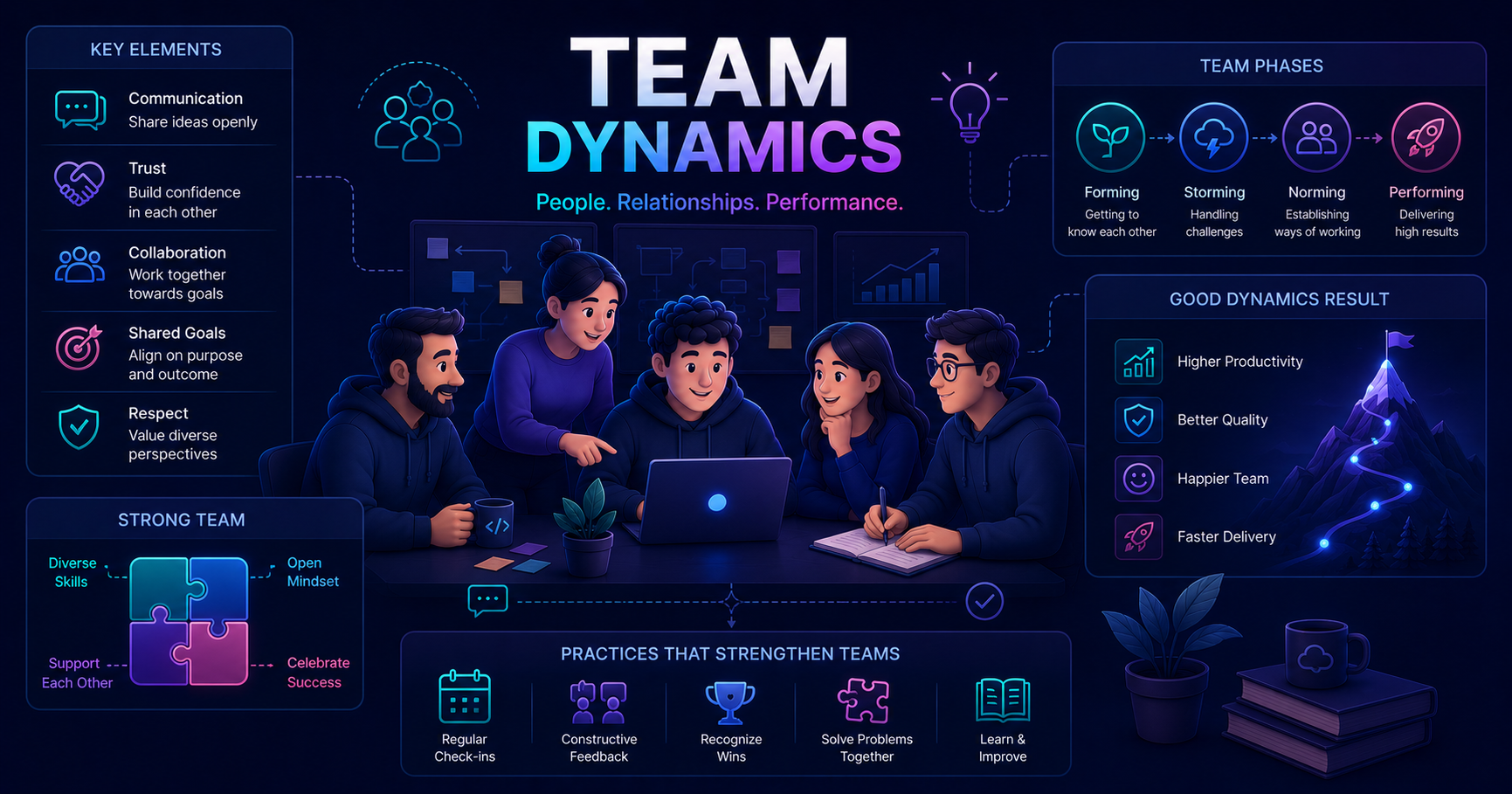
This post is part of our Soft Skills series for software engineers. Understanding team dynamics builds on the foundation of Self-Management and Positive Work Attitude, check those out first if you haven’t already!
What Is Team Dynamics for Junior Developers?
When you hear “team dynamics,” you might think it’s only relevant for managers and team leads. But here’s the truth: understanding team dynamics is crucial for every team member, especially junior developers who are just beginning their careers.
For junior developers, team dynamics means:
- Understanding how your team functions and your role within it
- Communicating effectively with various team members and stakeholders
- Contributing positively to team dynamics and culture
- Collaborating with different roles (developers, QA, designers, product managers)
- Helping your team achieve its goals while growing professionally
- Building strong working relationships that support career growth
Think of it this way: you may not be managing the team, but you’re managing your contribution to the team’s success.
According to MindTools, understanding team dynamics helps everyone work together productively. As a junior developer, learning these concepts early accelerates your professional growth and makes you a valued team member.
Why Team Dynamics Skills Matter for Juniors
Software development is rarely a solo endeavor. Even the most brilliant code is useless if it doesn’t integrate with the team’s work or meet user needs. Here’s why team skills are critical:
| Aspect | Why It Matters | Impact Without These Skills |
|---|---|---|
| Code Integration | Your code must work with others’ code | Merge conflicts, broken builds, wasted time |
| Knowledge Sharing | Learning from experienced teammates accelerates growth | Slower learning, repeated mistakes |
| Problem Solving | Complex problems require diverse perspectives | Stuck on problems, suboptimal solutions |
| Career Growth | Team members advocate for promotions and opportunities | Limited advancement, missed opportunities |
| Work Quality | Team collaboration catches bugs and improves designs | Lower quality code, more production issues |
| Job Satisfaction | Positive team dynamics make work enjoyable | Stress, burnout, job dissatisfaction |
"During my first project as a junior developer, I focused solely on writing perfect code in isolation. I missed standup meetings, rarely asked questions, and submitted PRs without context. My code was decent, but my team struggled to integrate it, and I wasn't learning much. Once I started actively participating in team discussions, asking questions, and understanding how my work fit the bigger picture, everything changed. I learned faster, my code improved, and work became collaborative instead of isolating."
Understanding Your Development Team Structure
Before you can effectively contribute to your team, you need to understand its structure and the various roles that make it function.
Typical Software Development Team Roles
flowchart TB
    subgraph Leadership["Leadership Layer"]
        EM[Engineering Manager]
        TL[Tech Lead]
        PO[Product Owner/Manager]
    end

    subgraph Development["Development Layer"]
        SD[Senior Developers]
        MD[Mid-Level Developers]
        JD[Junior Developers - YOU]
    end

    subgraph Support["Supporting Roles"]
        QA[QA Engineers]
        UX[UX/UI Designers]
        SA[System Architects]
        DevOps[DevOps Engineers]
    end

    subgraph Stakeholders["Stakeholders"]
        Client[Clients/Users]
        Bus[Business Analysts]
        SM[Scrum Master]
    end

    EM --> SD
    EM --> MD
    EM --> JD
    TL -.mentors.-> SD
    TL -.mentors.-> MD
    TL -.mentors.-> JD
    SD -.mentors.-> MD
    SD -.mentors.-> JD
    MD -.mentors.-> JD

    PO --> EM
    PO --> TL

    JD <--> QA
    JD <--> UX
    JD <--> DevOps

    SM -.facilitates.-> Development
    Bus -.provides requirements.-> Development
    Client -.provides feedback.-> PO

    style JD fill:#4CAF50,stroke:#2E7D32,stroke-width:3px,color:#fff
Engineering Manager
Oversees team performance and career development.
What they do:
- Manages team resources and priorities
- Conducts 1-on-1s and performance reviews
- Removes organizational blockers
- Advocates for the team’s needs
How to work with them as a junior:
- Be proactive in 1-on-1s, come with questions and updates
- Communicate blockers early before they become critical
- Ask for feedback on your growth and performance
- Be honest about workload and challenges
Tech Lead
Provides technical direction and architecture guidance.
What they do:
- Makes technical decisions and sets coding standards
- Reviews complex pull requests and designs
- Mentors developers on technical challenges
- Ensures code quality and architectural consistency
How to work with them as a junior:
- Ask technical questions, they expect and welcome them
- Propose solutions before asking for answers
- Learn from their PR comments and apply feedback broadly
- Follow established patterns and conventions
Senior/Mid-Level Developers
Your primary mentors and collaborators.
What they do:
- Implement complex features and tackle technical debt
- Mentor junior developers through pairing and reviews
- Design solutions and evaluate technical approaches
- Lead by example in code quality and best practices
How to work with them as a junior:
- Pair program when possible, it’s accelerated learning
- Ask “why” to understand reasoning behind decisions
- Review their code to learn patterns and techniques
- Offer to help with research or smaller subtasks
QA Engineers
Your partners in quality assurance.
What they do:
- Create test plans and test cases
- Find bugs before they reach production
- Verify features meet requirements
- Advocate for edge cases and user experience
How to work with them as a junior:
- Test your own code thoroughly before handoff
- Provide clear context in tickets and demos
- Respond quickly to bug reports with questions
- Learn common issues they find to prevent them
- Appreciate their work, they’re protecting users and your reputation
UX/UI Designers
Define the user experience and interface.
What they do:
- Design user interfaces and interaction flows
- Create mockups, prototypes, and design systems
- Advocate for user needs and accessibility
- Define visual consistency across the application
How to work with them as a junior:
- Implement designs as specified, don’t improvise without discussion
- Ask questions when designs are unclear or technically challenging
- Provide feedback on technical feasibility early
- Learn basic design principles to improve communication
Product Owner/Manager
Defines what gets built and why.
What they do:
- Prioritizes features and requirements
- Communicates business value and user needs
- Makes trade-off decisions between features
- Represents customer and stakeholder interests
How to work with them as a junior:
- Ask about the “why” behind features, understand business context
- Communicate technical constraints clearly and early
- Suggest improvements when you see opportunities
- Focus on delivering value, not just writing code
Your Role as a Junior Developer
Understanding your position helps you contribute effectively:
Your Primary Responsibilities:
- Implementing well-defined features and bug fixes
- Writing clean, tested, and maintainable code
- Learning from code reviews and feedback
- Asking questions when unclear about requirements or approaches
- Participating actively in team ceremonies (standups, retros, planning)
- Documenting your work clearly
What’s NOT Expected (Yet):
- Making major architectural decisions alone
- Mentoring other developers
- Defining product roadmaps
- Being an expert in every technology
- Never needing help or asking questions
You’re not expected to know everything, but you ARE expected to communicate, learn, and contribute positively to the team!
Key Team Dynamics Concepts for Junior Developers
Let’s explore essential team dynamics principles that will help you excel as a team member, based on established frameworks and adapted for junior developers.
1. Effective Communication
Communication is your most important non-technical skill. Poor communication creates confusion, wasted effort, and frustration, good communication multiplies your effectiveness.
flowchart LR
    subgraph Clear["Clear Communication"]
        C1[Specific]
        C2[Timely]
        C3[Respectful]
        C4[Documented]
    end

    subgraph Results["Positive Results"]
        R1[Faster Development]
        R2[Fewer Mistakes]
        R3[Better Relationships]
        R4[Increased Trust]
    end

    C1 --> R1
    C2 --> R2
    C3 --> R3
    C4 --> R4

    style Clear fill:#2196F3,stroke:#1565C0,color:#fff
    style Results fill:#4CAF50,stroke:#2E7D32,color:#fff
Communication Best Practices
In Daily Standups:
- Prepare your update before the meeting (Yesterday/Today/Blockers)
- Be concise, save detailed discussions for after
- Speak up about blockers immediately, don’t wait
1
2
3
4
5
❌ Bad: "I worked on stuff. I'll keep working on stuff."

✅ Good: "Yesterday I finished the login validation. Today I'm starting
the password reset feature. I'm blocked on the email service configuration,
can someone help me after standup?"
In Code Reviews:
- Ask questions instead of making demands
- Explain your reasoning when suggesting changes
- Accept feedback graciously, it’s about improving the code, not personal criticism
1
2
3
4
❌ Bad Comment: "This is wrong. Do it this way instead."

✅ Good Comment: "Have you considered using a HashMap here?
It would improve lookup time from O(n) to O(1). What do you think?"
When Asking Questions:
- Do your research first (Google, docs, past tickets)
- Provide context: what you tried, what error you got
- Ask specific questions, not just “it doesn’t work”
- Respect others’ time, batch similar questions when possible
1
2
3
4
5
6
❌ Bad Question: "The API isn't working. Help!"

✅ Good Question: "I'm getting a 401 error when calling POST /api/users.
I've verified my auth token is valid and I can successfully call GET endpoints.
I checked the API docs and my request body matches the schema.
Any ideas what else could cause this?"
When Reporting Bugs:
- Include steps to reproduce
- Provide expected vs. actual behavior
- Add relevant logs, screenshots, or error messages
- Specify environment (local, staging, production)
2. Collaboration and Teamwork
Collaboration isn’t just working alongside others, it’s actively working together to achieve shared goals.
Pair Programming
Two developers working together on one computer.
Benefits for juniors:
- Learn faster by watching experienced developers think through problems
- Get immediate feedback on your approach
- Build confidence by contributing to complex features
- Develop communication skills
How to be a good pair programming partner:
- As the Driver (typing): Narrate your thinking process, ask questions freely
- As the Navigator (observing): Point out issues constructively, suggest alternatives
- Switch roles regularly: Both people should get hands-on time
- Stay engaged: Don’t tune out when you’re not typing
- Take breaks: Pairing is mentally intense
Example pairing session structure:
- Setup (5 min): Review the task together, clarify requirements
- Work (25 min): Driver writes code while Navigator reviews
- Switch (5 min): Change roles, discuss what was done
- Repeat: Continue cycles with breaks
Code Reviews
Collaborative code quality improvement.
Receiving code reviews as a junior:
- Don’t take feedback personally, it’s about the code
- Ask for clarification if you don’t understand suggestions
- Learn patterns from repeated feedback and apply them proactively
- Thank reviewers for their time and insights
- Fix issues promptly and re-request review
Giving code reviews as a junior:
- Yes, you should review others’ code! It’s a learning opportunity
- Focus on what you understand: readability, obvious bugs, test coverage
- Ask questions: “Can you explain why you chose this approach?”
- Point out what’s good, not just problems
- Be humble, phrase suggestions as questions or learning opportunities
Code review example:
1
2
3
4
5
6
7
8
9
10
11
12
// Original code in PR
public void processOrder(Order order) {
    if (order != null) {
        if (order.getItems() != null) {
            if (order.getItems().size() > 0) {
                for (Item item : order.getItems()) {
                    processItem(item);
                }
            }
        }
    }
}
Junior’s review comment:
1
2
3
4
5
6
7
8
9
10
11
12
13
14
I noticed this has several nested if statements. I recently learned about
guard clauses that might make this more readable:

public void processOrder(Order order) {
    if (order == null || order.getItems() == null || order.getItems().isEmpty()) {
        return;
    }

    for (Item item : order.getItems()) {
        processItem(item);
    }
}

What do you think? Let me know if I'm missing something!
Knowledge Sharing
Contributing to collective team intelligence.
Ways to share knowledge as a junior:
- Document your learning: Write internal docs about challenges you solved
- Present in team meetings: Share new tools or techniques you discovered
- Update README files: Improve setup instructions when you struggle with them
- Create runbooks: Document repetitive tasks for others
- Ask questions publicly: In team chat instead of DMs (others likely have same question)
Benefits:
- Reinforces your own learning (teaching solidifies knowledge)
- Helps future team members (including future you)
- Establishes you as a proactive contributor
- Makes you more visible to leadership
3. Building Strong Team Relationships
Technical skills get you hired, but relationships determine your career trajectory. People advocate for colleagues they trust and respect.
Relationship-Building Strategies
1. Be Reliable:
- Meet your commitments or communicate early when you can’t
- Show up to meetings on time and prepared
- Follow through on action items from discussions
- Update tickets and documentation consistently
2. Show Genuine Interest:
- Learn teammates’ names and roles immediately
- Ask about their work and expertise
- Remember personal details they share (within appropriate bounds)
- Celebrate team wins and acknowledge individual contributions
3. Be Helpful:
- Volunteer for unglamorous tasks occasionally
- Help with code reviews promptly
- Share useful resources when you find them
- Offer assistance when teammates are swamped
4. Practice Emotional Intelligence:
- Read the room, is this a good time for questions?
- Notice when teammates are stressed and offer support
- Manage your own frustration professionally
- Apologize when you make mistakes that affect others
5. Participate in Team Activities:
- Join team lunches or coffee breaks
- Engage in team chat (but don’t distract)
- Participate in retrospectives honestly
- Attend optional team events when you can
Building relationships doesn’t mean you need to be best friends with everyone. It means being professional, respectful, and genuinely collaborative.
Working with Different Roles
Each role on your team has different priorities, constraints, and communication styles. Understanding these helps you collaborate effectively.
Communication Strategies by Role
| Role | Their Priority | What They Need From You | Communication Tips |
|---|---|---|---|
| Engineering Manager | Team productivity, morale, delivery | Honest status updates, early escalation of blockers | Regular 1-on-1s, proactive communication |
| Tech Lead | Technical quality, architecture, standards | Follow conventions, ask architectural questions early | Technical discussions, document decisions |
| Senior Developers | Feature delivery, mentoring, code quality | Be prepared with what you’ve tried, specific questions | Respect their time, show effort first |
| QA Engineers | Quality, edge cases, user experience | Thorough testing before handoff, clear feature explanations | Detailed bug reports, respect for their findings |
| Designers | User experience, visual consistency, accessibility | Faithful implementation, early technical feasibility feedback | Screenshots of implementation, questions about intent |
| Product Managers | Business value, user needs, deadlines | Technical constraints, effort estimates, alternative solutions | Business context questions, realistic commitments |
| DevOps | Reliability, performance, security, deployments | Follow deployment procedures, write deployment docs | Infrastructure questions, deployment coordination |
Example Interactions
With QA:
1
2
3
4
5
6
7
❌ Bad: Marking ticket as "Done" after writing code without testing

✅ Good: Testing thoroughly yourself, then providing QA with:
- What to test
- Any edge cases you're concerned about
- Test data to use
- Expected behavior clearly documented
With Product Manager:
1
2
3
4
5
❌ Bad: "This will take forever to build, it's a stupid feature."

✅ Good: "I understand the value here. The current approach would take
about 3 weeks. If we simplified to handle just the main use case first,
we could deliver in 1 week and iterate based on user feedback. Would that work?"
With Tech Lead:
1
2
3
4
5
6
7
❌ Bad: "How do I implement authentication?"

✅ Good: "I'm implementing authentication for the user service.
I've researched JWT vs session-based auth, and I think JWT makes sense
because we're building a stateless API. I've looked at Spring Security's
JWT support. Does this approach align with our architecture?
Any gotchas I should know about?"
Navigating Common Team Challenges
Every team faces challenges. How you respond to these situations defines your reputation and growth trajectory.
Challenge 1: Disagreements About Technical Approaches
Scenario: You think your approach is better than what your senior developer suggests.
Poor Response:
- Argue defensively
- Ignore the feedback and implement your way
- Complain to other team members
- Get emotional or take it personally
Professional Response:
- Listen fully: Understand their reasoning completely
- Ask questions: “Can you help me understand why X is better than Y?”
- Present your case respectfully: “I see your point. I was thinking Y might be better because [reasons]. What am I missing?”
- Accept the decision: Even if you disagree, implement their approach and learn from it
- Follow up later: If your concerns prove valid, discuss respectfully with data
flowchart TB
    Conflict[Technical Disagreement] --> Listen[Listen to Their Reasoning]
    Listen --> Understand{Do You Understand Their Point?}
    Understand -->|No| Ask[Ask Clarifying Questions]
    Ask --> Listen
    Understand -->|Yes| Agree{Do You Agree?}
    Agree -->|Yes| Implement1[Implement Agreed Solution]
    Agree -->|No| Present[Present Your Case Respectfully]
    Present --> Decision{Their Final Decision?}
    Decision --> Implement2[Implement Decided Solution]
    Implement2 --> Learn[Learn From the Approach]
    Learn --> Reflect[Reflect on Outcome Later]

    style Conflict fill:#FF5252,stroke:#D32F2F,color:#fff
    style Implement1 fill:#4CAF50,stroke:#2E7D32,color:#fff
    style Implement2 fill:#4CAF50,stroke:#2E7D32,color:#fff
    style Learn fill:#2196F3,stroke:#1565C0,color:#fff
Remember: Senior developers usually have context and experience you lack. Even when you disagree, implementing their approach teaches you something valuable.
Challenge 2: Feeling Overwhelmed or Behind
Scenario: Everyone seems to understand things faster than you, and you’re struggling to keep up.
Poor Response:
- Suffer in silence, pretending to understand
- Work excessive hours trying to catch up alone
- Conclude you’re not cut out for software development
- Avoid asking questions to hide your struggles
Professional Response:
- Normalize the feeling: Every junior developer feels this way (seriously, ALL of them)
- Identify specific gaps: What exactly don’t you understand?
- Ask targeted questions: Focus on one gap at a time
- Request resources: “Are there docs or examples I should review?”
- Communicate workload concerns: “I’m spending a lot of time on X. Can we discuss?”
- Seek mentorship: “Would you have time to pair on this to help me understand?”
"For my first six months, I felt like the dumbest person on the team. Everyone else seemed to solve problems instantly while I struggled with basics. I finally admitted to my senior that I was struggling. She said, 'Good! If you weren't struggling, we wouldn't be challenging you enough. Let me show you how I approach these problems.' That conversation changed everything. Now I actively share when I'm stuck, it's how I learn fastest."
Challenge 3: Communication Breakdowns
Scenario: You completed a feature, but it’s not what the product manager wanted.
Poor Response:
- Blame the PM for unclear requirements
- Get defensive about your implementation
- Refuse to redo the work
- Complain about wasted time
Professional Response:
- Take responsibility: “I should have clarified this earlier.”
- Understand the gap: “Let me make sure I understand what’s actually needed.”
- Learn from it: “What questions should I have asked to catch this earlier?”
- Fix it professionally: “I’ll revise this. Should take about X time.”
- Prevent recurrence: Next time, ask for examples, mockups, or user stories upfront
Preventive strategies:
- Repeat requirements back in your own words
- Ask for examples of expected behavior
- Request mockups or wireframes for UI features
- Break down requirements into smaller, verifiable pieces
- Demo work-in-progress earlier for feedback
Practical Exercises for Team Success
Here are concrete actions you can take this week to improve your team contributions:
Week 1: Observation and Understanding
Goals: Understand your team’s structure and dynamics
- Map your team: Create a diagram of roles and how they interact
- Study ceremonies: Note how standups, retros, and planning work
- Identify communication patterns: Where do different discussions happen? (Slack, email, meetings)
- Find documentation: Locate team conventions, coding standards, runbooks
- Ask for context: “Can you explain how our team is structured and how we work together?”
Week 2: Active Communication
Goals: Improve communication clarity and frequency
- Prepare for standup: Write your update before the meeting
- Ask one clarifying question: When receiving a task, ask about edge cases or requirements
- Document something: Update README, write a ticket comment, or document a solution
- Respond promptly: Reply to PR comments and questions within 4 hours
- Over-communicate status: Update tickets when starting, blocking, or completing
Week 3: Collaboration
Goals: Work more closely with teammates
- Request a pairing session: Ask a senior to pair on a tricky feature
- Review someone’s PR: Provide thoughtful, constructive feedback
- Help a teammate: Offer assistance when you see someone struggling
- Share something useful: Article, tool, or technique you discovered
- Participate in retrospective: Share one thing that went well and one improvement idea
Week 4: Relationship Building
Goals: Strengthen connections with team members
- Schedule coffee chats: 15-30 minute informal conversations with different teammates
- Learn about their work: Ask what they’re working on and what interests them
- Express appreciation: Thank someone who helped you, publicly or privately
- Contribute to team culture: Participate in team chat, celebrate a win, or bring energy
- Follow up on discussions: Reference previous conversations to show you listen
The Team Player Mindset
As we wrap up, let’s crystallize the core mindset that makes someone an exceptional team member:
mindmap
  root((Excellent<br/>Team Member))
    Communicate
      Clearly
      Proactively
      Respectfully
      Frequently
    Collaborate
      Pair willingly
      Review thoughtfully
      Share knowledge
      Ask for help
    Contribute
      Complete tasks
      Help others
      Improve processes
      Stay positive
    Learn
      Accept feedback
      Ask questions
      Study team norms
      Grow skills
    Build Trust
      Be reliable
      Show effort
      Own mistakes
      Celebrate others
Key Principles to Remember:
- Your code is a team effort: It’s not about your individual brilliance, but collective success
- Communication is as important as code: Clear communication prevents more bugs than perfect code
- Questions are strengths, not weaknesses: They demonstrate engagement and desire to understand
- Relationships matter: Technical skills get you in the door, relationships build your career
- Attitude multiplies impact: Positive, collaborative developers make everyone around them better
- You’re always learning: Being junior is temporary; how you approach it shapes your entire career
“The strength of the team is each individual member. The strength of each member is the team.” - Phil Jackson
Common Mistakes to Avoid
As you develop your team skills, watch out for these common junior developer pitfalls:
| Mistake | Why It’s Problematic | Better Approach |
|---|---|---|
| Suffering in silence | Problems compound, deadlines slip, stress increases | Communicate blockers early and often |
| Avoiding code reviews | Miss learning opportunities, code quality suffers | Engage actively in giving and receiving reviews |
| Working in isolation | Get stuck longer, miss context, poor integration | Communicate progress, ask questions, pair when stuck |
| Taking feedback personally | Damages relationships, prevents growth | Separate code from self-worth, welcome improvement |
| Skipping team ceremonies | Miss context, appear disengaged, lose alignment | Attend consistently, participate actively |
| Never saying no | Burnout, poor quality, missed commitments | Be honest about capacity, propose priorities |
| Pretending to understand | Build on wrong assumptions, deliver wrong solutions | Ask clarifying questions, verify understanding |
| Comparing yourself to seniors | Discouragement, imposter syndrome, unrealistic expectations | Compare to past self, celebrate growth |
Conclusion: You’re Part of Something Bigger
As a junior developer, it’s easy to focus solely on writing code and solving technical problems. But here’s what experience teaches: your ability to work effectively within a team will shape your career far more than your ability to write clever algorithms.
The best software engineers aren’t just great coders, they’re:
- Great communicators who keep everyone aligned
- Reliable team members who others trust and want to work with
- Continuous learners who grow both technical and interpersonal skills
- Positive contributors who make their teams stronger
You don’t need to be perfect at all of this immediately. Team skills, like technical skills, develop through practice, feedback, and reflection. Start with small improvements:
- Ask better questions this week
- Give one thoughtful code review
- Thank someone who helped you
- Share something you learned
Each small action builds the reputation and relationships that will carry your career forward.
Remember: you were hired not just to write code, but to contribute to your team’s success. When you help your team win, you win too.
For more on building the foundational skills that make you an effective team member, explore our posts on Self-Management, Positive Work Attitude, and Work-Life Balance.
Additional Resources
- MindTools: Team Dynamics - Comprehensive guide to team dynamics principles
- MindTools: Working with Others - Strategies for effective collaboration
- The Five Dysfunctions of a Team by Patrick Lencioni - Understanding team dynamics
- Radical Candor by Kim Scott - Giving and receiving feedback effectively
Now go forth and be the team member everyone wants to work with! 🚀