
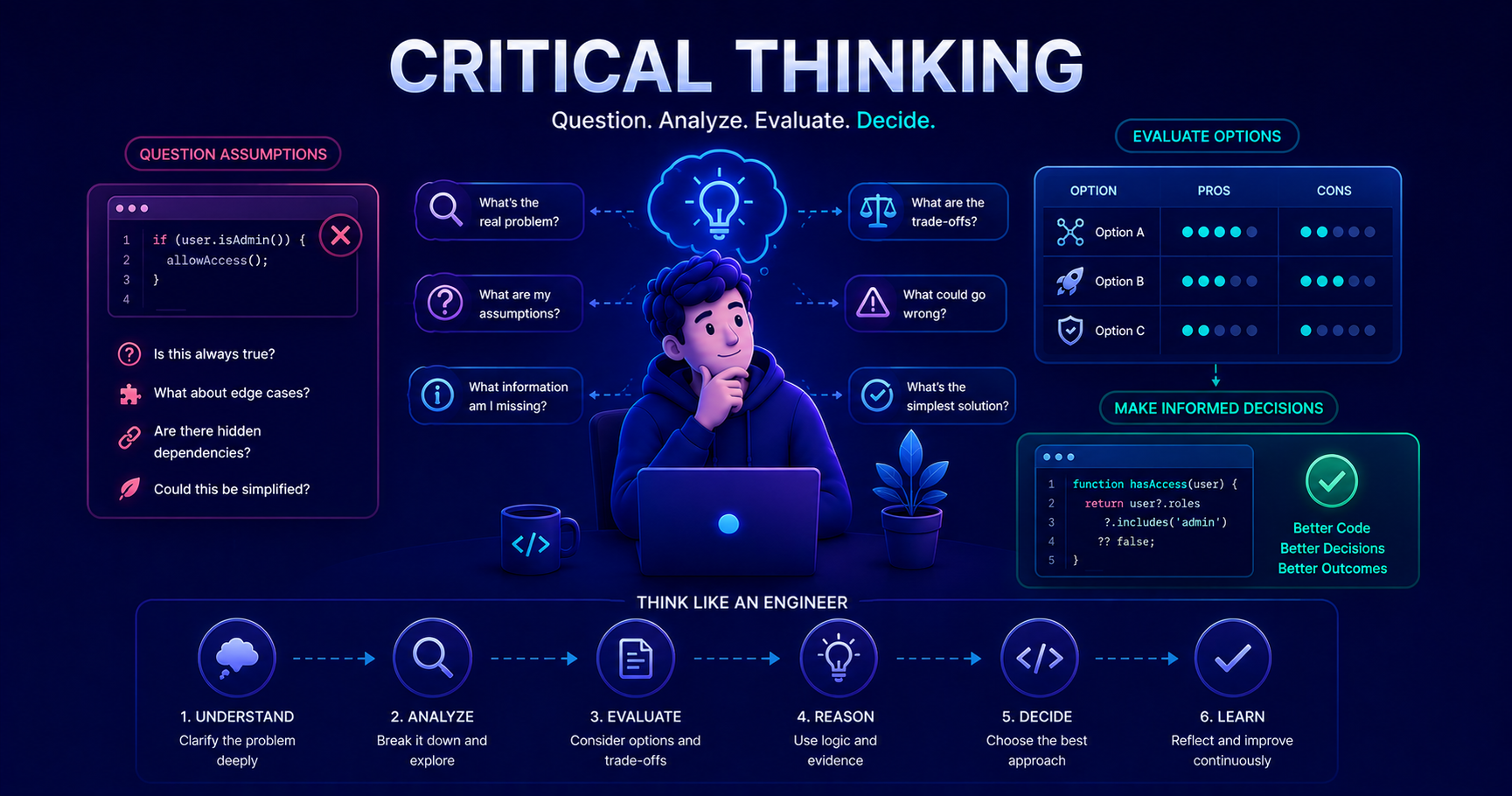
This post builds upon our Problem Solving post. While problem-solving focuses on finding solutions, critical thinking helps you evaluate whether those solutions are actually good!
What Is Critical Thinking?
As software engineers, we solve problems every day. But here’s the thing: not all solutions are created equal. Critical thinking is the skill that helps us distinguish good solutions from bad ones, question our assumptions, and make informed technical decisions.
"Any fool can write code that a computer can understand. Good programmers write code that humans can understand." - Martin Fowler
Critical thinking in software development means:
- Analyzing code, requirements, and design decisions objectively
- Questioning assumptions and challenging the status quo
- Evaluating multiple solutions against clear criteria
- Recognizing biases and logical fallacies in technical discussions
- Making informed decisions based on evidence and reasoning
This post draws inspiration from Pavel Polivka’s excellent article on Critical Thinking for Developers, adapted with practical examples for our Software Engineering Growth community.
Problem Solving vs. Critical Thinking
Let’s clarify the difference with a real-world example:
| Aspect | Problem Solving | Critical Thinking |
|---|---|---|
| Focus | Finding a solution | Finding the best solution |
| Approach | “How do I make this work?” | “Is this the right approach?” |
| Questions | “What should I do?” | “Why should I do it this way?” |
| Evaluation | Does it work? | Does it work well? Is it maintainable? |
| Scope | Immediate problem | Broader implications and trade-offs |
Example Scenario:
You need to store user preferences in your application.
Problem Solving Answer:
1
2
3
4
5
6
7
8
9
10
11
12
// Quick solution: Store everything in a HashMap
public class UserPreferences {
    private static Map<String, String> preferences = new HashMap<>();

    public void setPreference(String key, String value) {
        preferences.put(key, value);
    }

    public String getPreference(String key) {
        return preferences.get(key);
    }
}
Critical Thinking Questions:
- Is in-memory storage appropriate, or do we need persistence?
- What happens when the application restarts?
- Are all preferences really strings, or do we need type safety?
- How will this scale with multiple users?
- What are the security implications?
- Is this testable and maintainable?
Improved Solution (after critical thinking):
1
2
3
4
5
6
7
8
9
10
11
12
13
14
15
16
17
18
19
20
21
22
23
24
25
26
27
28
29
30
31
32
33
34
35
36
37
// More thoughtful solution considering persistence and type safety
public class UserPreferencesService {
    private final PreferenceRepository repository;
    private final PreferenceValidator validator;

    public UserPreferencesService(PreferenceRepository repository,
                                  PreferenceValidator validator) {
        this.repository = repository;
        this.validator = validator;
    }

    public <T> void setPreference(String userId, PreferenceKey<T> key, T value) {
        // Validate before storing
        validator.validate(key, value);

        // Persist to database
        repository.save(userId, key.getName(), key.serialize(value));
    }

    public <T> Optional<T> getPreference(String userId, PreferenceKey<T> key) {
        return repository.findByUserAndKey(userId, key.getName())
            .map(key::deserialize);
    }
}

// Type-safe preference keys
public class PreferenceKey<T> {
    private final String name;
    private final Class<T> type;

    public static final PreferenceKey<String> THEME =
        new PreferenceKey<>("theme", String.class);
    public static final PreferenceKey<Boolean> NOTIFICATIONS_ENABLED =
        new PreferenceKey<>("notifications.enabled", Boolean.class);

    // Serialization logic...
}
Core Critical Thinking Skills for Developers
flowchart TB
    subgraph CT[Critical Thinking Skills]
        direction TB

        subgraph Analysis["🔍 Analysis"]
            A1[Break down problems]
            A2[Identify patterns]
            A3[Examine assumptions]
        end

        subgraph Evaluation["⚖️ Evaluation"]
            E1[Assess trade-offs]
            E2[Compare alternatives]
            E3[Measure quality]
        end

        subgraph Inference["💡 Inference"]
            I1[Draw conclusions]
            I2[Predict outcomes]
            I3[Identify implications]
        end

        subgraph Reflection["🤔 Reflection"]
            R1[Challenge biases]
            R2[Learn from mistakes]
            R3[Seek feedback]
        end
    end

    Analysis --> Evaluation
    Evaluation --> Inference
    Inference --> Reflection
    Reflection --> Analysis
Let’s explore each skill with practical examples.
1. Analysis: Breaking Down Complexity
Analysis
the ability to break down complex problems and examine their components objectively.
What it looks like in code:
Instead of accepting this code at face value:
1
2
3
4
5
6
7
8
public void processOrder(Order order) {
    order.validate();
    order.calculateTotal();
    order.applyDiscounts();
    order.processPayment();
    order.sendConfirmation();
    order.updateInventory();
}
Critical analysis questions:
- What if validation fails?
- What if payment processing fails after discounts are applied?
- Are these operations transactional?
- What’s the order of operations, and does it matter?
- What are the dependencies between these steps?
Improved version after analysis:
1
2
3
4
5
6
7
8
9
10
11
12
13
14
15
16
17
18
19
20
21
22
23
24
25
public OrderResult processOrder(Order order) {
    // Step 1: Validate (fast fail)
    ValidationResult validation = orderValidator.validate(order);
    if (!validation.isValid()) {
        return OrderResult.failed(validation.getErrors());
    }

    // Step 2: Calculate and apply discounts
    OrderPricing pricing = pricingService.calculatePricing(order);

    // Step 3: Process payment (external operation, may fail)
    try {
        PaymentResult payment = paymentService.process(pricing);

        // Step 4: Only update inventory and send confirmation if payment succeeds
        inventoryService.reserveItems(order.getItems());
        notificationService.sendConfirmation(order, payment);

        return OrderResult.success(order.getId(), payment);

    } catch (PaymentException e) {
        // No side effects occurred, safe to fail
        return OrderResult.failed("Payment failed: " + e.getMessage());
    }
}
2. Evaluation: Weighing Trade-offs
Evaluation
assessing different approaches against relevant criteria and understanding trade-offs.
Scenario: You need to implement a caching mechanism.
Let’s evaluate three approaches critically:
flowchart LR
    subgraph Options[Caching Options]
        direction TB
        O1[In-Memory Cache]
        O2[Distributed Cache Redis]
        O3[Database Caching]
    end

    subgraph Criteria[Evaluation Criteria]
        direction TB
        C1[Performance]
        C2[Scalability]
        C3[Consistency]
        C4[Complexity]
        C5[Cost]
    end

    Options --> Criteria
| Criteria | In-Memory (e.g., Caffeine) | Distributed (e.g., Redis) | Database Caching |
|---|---|---|---|
| Performance | ⭐⭐⭐⭐⭐ Fastest | ⭐⭐⭐⭐ Very fast | ⭐⭐ Slower |
| Scalability | ⭐⭐ Per-instance only | ⭐⭐⭐⭐⭐ Highly scalable | ⭐⭐⭐ Good |
| Consistency | ⭐⭐ Can become stale | ⭐⭐⭐⭐ Centralized | ⭐⭐⭐⭐⭐ Always fresh |
| Complexity | ⭐⭐⭐⭐⭐ Simple | ⭐⭐⭐ Moderate | ⭐⭐⭐⭐ Simple |
| Cost | ⭐⭐⭐⭐⭐ Free (memory) | ⭐⭐ Infrastructure cost | ⭐⭐⭐⭐ Existing DB |
Critical thinking process:
1
2
3
4
5
6
7
8
9
10
11
12
13
14
15
16
17
18
19
20
21
22
23
24
25
26
27
28
29
30
31
32
33
34
35
36
37
38
39
40
41
42
43
44
// Ask yourself: What are we optimizing for?

// For frequently accessed, read-heavy data that doesn't change often:
@Service
public class ProductCatalogService {
    private final LoadingCache<String, Product> productCache;

    public ProductCatalogService(ProductRepository repository) {
        // In-memory cache is perfect here
        this.productCache = Caffeine.newBuilder()
            .maximumSize(10_000)
            .expireAfterWrite(1, TimeUnit.HOURS)
            .build(productId -> repository.findById(productId).orElse(null));
    }
}

// For user session data across multiple servers:
@Service
public class SessionService {
    private final RedisTemplate<String, Session> redisTemplate;

    // Distributed cache is necessary for horizontal scaling
    public void saveSession(Session session) {
        redisTemplate.opsForValue().set(
            "session:" + session.getId(),
            session,
            30,
            TimeUnit.MINUTES
        );
    }
}

// For critical financial data where consistency is paramount:
@Service
public class AccountBalanceService {
    private final AccountRepository repository;

    // No caching, always fetch fresh data
    public BigDecimal getBalance(String accountId) {
        return repository.findById(accountId)
            .map(Account::getBalance)
            .orElseThrow(() -> new AccountNotFoundException(accountId));
    }
}
The critical thinking question: “What happens if we choose wrong?”
- In-memory cache with multiple servers → Inconsistent user experience
- Redis for everything → Unnecessary complexity and cost
- No caching for product catalog → Poor performance and high DB load
3. Questioning Assumptions
One of the most powerful critical thinking skills is learning to question assumptions, both in requirements and in code.
Assumptions in Requirements
requirements often contain hidden assumptions that need to be challenged.
Example requirement: “Users should be able to delete their account.”
Questions to ask:
- Should deletion be immediate or scheduled?
- What happens to their data (GDPR compliance)?
- Can they recover their account?
- What if they have active subscriptions?
- What if other users reference their content?
1
2
3
4
5
6
7
8
9
10
11
12
13
14
15
16
17
18
19
20
21
22
23
24
25
26
27
28
29
30
31
32
33
// Naive implementation (assumptions not questioned)
public void deleteAccount(String userId) {
    userRepository.deleteById(userId);
    // Done! Or is it?
}

// Critical thinking applied
public AccountDeletionResult deleteAccount(String userId, DeletionRequest request) {
    User user = userRepository.findById(userId)
        .orElseThrow(() -> new UserNotFoundException(userId));

    // Check business rules
    if (user.hasActiveSubscription()) {
        throw new CannotDeleteAccountException(
            "Cancel subscription before deleting account"
        );
    }

    // Handle data retention requirements (GDPR)
    if (request.isImmediateDeletion()) {
        anonymizeUserData(user);
    } else {
        scheduleDeletion(user, 30); // Grace period
    }

    // Handle referential integrity
    transferOrArchiveUserContent(user);

    // Audit trail (compliance)
    auditLog.logAccountDeletion(user, request);

    return AccountDeletionResult.scheduled(user.getId(), request.getDeletionDate());
}
Assumptions in Code
code often makes implicit assumptions that should be explicit and validated.
Example: Finding dangerous assumptions
1
2
3
4
5
// What assumptions does this code make?
public double calculateAverage(List<Integer> numbers) {
    int sum = numbers.stream().mapToInt(Integer::intValue).sum();
    return sum / numbers.size();
}
Hidden assumptions:
- ❌
numbersis not null - ❌
numbersis not empty - ❌ Sum won’t overflow
- ❌ Result fits in
doubleprecision
Critical thinking applied:
1
2
3
4
5
6
7
8
9
10
11
12
13
14
public OptionalDouble calculateAverage(List<Integer> numbers) {
    // Make assumptions explicit and handle them
    if (numbers == null || numbers.isEmpty()) {
        return OptionalDouble.empty();
    }

    // Use long to prevent overflow, then calculate average
    return OptionalDouble.of(
        numbers.stream()
            .mapToLong(Integer::longValue)
            .average()
            .orElse(0.0)
    );
}
Better yet, use the type system to eliminate invalid states:
1
2
3
4
5
6
7
8
9
10
11
// NonNull collection guarantees we have data
public double calculateAverage(@NonNull List<@NonNull Integer> numbers) {
    if (numbers.isEmpty()) {
        throw new IllegalArgumentException("Cannot calculate average of empty list");
    }

    return numbers.stream()
        .mapToLong(Integer::longValue)
        .average()
        .getAsDouble(); // Safe because we checked isEmpty
}
Critical Thinking in Code Reviews
Code reviews are a prime opportunity to practice and demonstrate critical thinking. Here’s how to review code critically:
flowchart TD
    Start[Code Review] --> Q1{Is the approach appropriate?}

    Q1 -->|Question it| A1[Consider alternatives]
    Q1 -->|Seems good| Q2{Are edge cases handled?}

    A1 --> Suggest[Suggest better approach]

    Q2 -->|Missing cases| A2[Identify gaps]
    Q2 -->|Covered| Q3{Is it maintainable?}

    A2 --> Request[Request additional tests]

    Q3 -->|Hard to understand| A3[Ask for clarification]
    Q3 -->|Clear| Q4{Are there side effects?}

    A3 --> Improve[Suggest improvements]

    Q4 -->|Potential issues| A4[Highlight concerns]
    Q4 -->|Safe| Approve[Approve with insights]

    A4 --> Discuss[Discuss trade-offs]
Good vs. Poor Code Review Comments
| Poor Critical Thinking | Good Critical Thinking |
|---|---|
| “This looks wrong.” | “This assumes the list is never empty. What happens on line 47 if it is?” |
| “Use a different pattern.” | “Have we considered the Strategy pattern here? It would make testing easier and reduce coupling.” |
| “Too complex.” | “This method has 4 responsibilities. Could we extract the validation and transformation logic into separate methods?” |
| “Needs tests.” | “We’re missing test cases for null input and concurrent access. These could cause issues in production.” |
Practical Code Review Example
Pull Request: Adding user authentication
1
2
3
4
5
6
7
8
9
10
11
12
13
14
15
16
@RestController
public class AuthController {

    @Autowired
    private UserRepository userRepository;

    @PostMapping("/login")
    public String login(@RequestBody LoginRequest request) {
        User user = userRepository.findByUsername(request.getUsername());

        if (user.getPassword().equals(request.getPassword())) {
            return "SUCCESS";
        }
        return "FAILED";
    }
}
Critical thinking review comments:
🔴 Security: Plain text passwords
This code compares passwords as plain text. We should:
- Never store plain text passwords (use BCrypt/Argon2)
- Use
PasswordEncoder.matches()for comparison- Consider timing attacks (constant-time comparison)
🟡 Null pointer risk
Line 9: What iffindByUsername()returns null? This will cause a NullPointerException. Consider usingOptional<User>or null check.
🟡 Missing authentication token
Returning “SUCCESS” doesn’t give the client a way to authenticate future requests. Should we return a JWT or session token?
🔵 No rate limiting
This endpoint is vulnerable to brute force attacks. Consider adding rate limiting or account lockout after N failed attempts.
Improved version after critical review:
1
2
3
4
5
6
7
8
9
10
11
12
13
14
15
16
17
18
19
20
21
22
23
24
25
26
27
28
29
30
31
32
33
@RestController
@RequestMapping("/api/auth")
public class AuthController {

    private final AuthenticationService authService;
    private final RateLimiter rateLimiter;

    @Autowired
    public AuthController(AuthenticationService authService, RateLimiter rateLimiter) {
        this.authService = authService;
        this.rateLimiter = rateLimiter;
    }

    @PostMapping("/login")
    public ResponseEntity<AuthResponse> login(@Valid @RequestBody LoginRequest request) {
        // Rate limiting protection
        if (rateLimiter.isLimitExceeded(request.getUsername())) {
            return ResponseEntity
                .status(HttpStatus.TOO_MANY_REQUESTS)
                .body(AuthResponse.rateLimitExceeded());
        }

        // Authenticate with secure password comparison
        return authService.authenticate(request.getUsername(), request.getPassword())
            .map(token -> ResponseEntity.ok(AuthResponse.success(token)))
            .orElseGet(() -> {
                rateLimiter.recordFailedAttempt(request.getUsername());
                return ResponseEntity
                    .status(HttpStatus.UNAUTHORIZED)
                    .body(AuthResponse.failed("Invalid credentials"));
            });
    }
}
Avoiding Cognitive Biases in Development
Critical thinkers recognize and combat cognitive biases that affect technical decisions.
Common Cognitive Biases in Software Development
Confirmation Bias
seeking information that confirms existing beliefs.
Example: You believe microservices are always better than monoliths. When evaluating architectures, you:
- Only research successful microservice case studies
- Ignore the operational complexity and costs
- Dismiss warnings about distributed systems
How to combat it:
1
2
3
4
5
6
7
8
9
10
11
12
13
14
15
16
17
18
19
20
21
22
23
24
25
26
27
28
// Force yourself to document BOTH pros and cons
/**
 * Architecture Decision Record: Service Architecture
 *
 * Context: Growing user base, team of 5 developers
 *
 * Option 1: Monolithic Architecture
 * Pros:
 *   - Simpler deployment and debugging
 *   - Easier to maintain with small team
 *   - Lower operational costs
 * Cons:
 *   - May become difficult to scale specific components
 *   - All code in one repository
 *
 * Option 2: Microservices Architecture
 * Pros:
 *   - Independent scaling of services
 *   - Technology flexibility
 * Cons:
 *   - Distributed system complexity
 *   - Requires more DevOps expertise
 *   - Network latency between services
 *   - More expensive infrastructure
 *
 * Decision: Start with Monolith, plan for modular design
 * Rationale: Small team, need to move fast, can refactor later
 */
Anchoring Bias
relying too heavily on the first piece of information encountered.
Example: The first solution you think of becomes the “anchor,” and all other solutions seem less attractive.
1
2
3
4
5
6
7
8
// First idea (anchor): Use a HashMap
Map<String, User> userCache = new HashMap<>();

// This becomes your mental baseline, and you might miss better alternatives:
// - ConcurrentHashMap (thread-safe)
// - WeakHashMap (memory-efficient)
// - LoadingCache (auto-loading)
// - Database with proper indexing (no cache needed)
How to combat it: Set a rule: Generate at least 3 different approaches before choosing one.
Sunk Cost Fallacy
continuing with a poor solution because you’ve already invested time in it.
Example: You’ve spent 3 days building a custom authentication system, then discover Spring Security does exactly what you need (and better).
Poor thinking: “I’ve already spent 3 days on this, I should finish it.”
Critical thinking: “Those 3 days are gone regardless. What’s the best path forward?”
1
2
3
4
5
6
7
8
9
10
11
12
13
14
15
16
17
18
19
20
21
22
// After 3 days of custom code...
public class CustomAuthenticationManager {
    // 500 lines of code
    // Missing edge cases
    // Not fully tested
    // Reinventing the wheel
}

// Critical thinking: Delete it and use proven solutions
@Configuration
@EnableWebSecurity
public class SecurityConfig extends WebSecurityConfigurerAdapter {
    @Override
    protected void configure(HttpSecurity http) throws Exception {
        http
            .authorizeRequests()
                .antMatchers("/api/public/**").permitAll()
                .anyRequest().authenticated()
            .and()
            .oauth2Login();
    }
}
Pro Tip: Keep a “graveyard” folder for deleted code. This makes it psychologically easier to abandon sunk costs, you can always retrieve it if needed (you won’t).
Dunning-Kruger Effect
overestimating your knowledge/abilities when you’re actually inexperienced.
Example: Junior developer: “Why do we need all these design patterns? I can just code it simply!”
1
2
3
4
5
6
7
8
9
10
// "Simple" code that seems fine at first
public class OrderService {
    public void processOrder(Order order) {
        // 300 lines of mixed concerns
        // Direct database calls
        // No error handling
        // Tightly coupled
        // Hard to test
    }
}
How to combat it:
- Seek code reviews from senior developers
- Study existing, mature codebases
- Read post-mortems of production failures
- Acknowledge what you don’t know
Developing Your Critical Thinking Muscle
Critical thinking is a skill you can practice and improve. Here are exercises to develop it:
Exercise 1: The “Why” Chain
For every technical decision, ask “Why?” five times.
Example:
- Decision: We should cache API responses.
- Why? To improve performance.
- Why improve performance?
- Because users complain about slow load times.
- Why are load times slow?
- Because we make multiple API calls per page.
- Why multiple API calls?
- Because the frontend fetches data independently for each component.
- Why does frontend fetch independently?
- Because we don’t have a backend-for-frontend (BFF) layer.
Insight: Maybe the real solution isn’t caching, but architectural change (BFF pattern).
Exercise 2: Devil’s Advocate
For every solution you propose, argue AGAINST it.
1
2
3
4
5
6
7
8
9
10
11
12
13
14
// Proposal: Use a NoSQL database for user data
public class UserService {
    private MongoTemplate mongoTemplate;
    // ...
}

// Now argue against it:
// - Our data is highly relational (users, orders, addresses)
// - We need ACID transactions
// - Team has no MongoDB experience
// - SQL databases can handle our scale
// - Harder to enforce data consistency

// Result: Stick with PostgreSQL for now
Exercise 3: Code Archaeology
Take a piece of code and reverse-engineer the thinking behind it.
1
2
3
4
5
6
7
8
9
10
11
12
13
14
15
16
17
18
19
public class RetryableHttpClient {
    private static final int MAX_RETRIES = 3;
    private static final long RETRY_DELAY_MS = 1000;

    public Response execute(Request request) {
        int attempts = 0;
        while (attempts < MAX_RETRIES) {
            try {
                return httpClient.execute(request);
            } catch (IOException e) {
                attempts++;
                if (attempts >= MAX_RETRIES) {
                    throw new MaxRetriesExceededException(e);
                }
                Thread.sleep(RETRY_DELAY_MS);
            }
        }
    }
}
Critical analysis questions:
- Why 3 retries specifically?
- Why linear backoff instead of exponential?
- What if the server is overloaded? (More retries make it worse)
- Should all exceptions be retried? (500 yes, 400 no)
- What about idempotency? (Some requests shouldn’t be retried)
Exercise 4: Teach Someone Else
Explaining your reasoning to others forces you to think critically about it.
Before: “I used a Singleton because we only need one instance.”
After teaching/explaining:
- “I used a Singleton for the ConfigurationManager because…”
- “Configuration is read-once and shared across the application”
- “However, this makes testing harder because it’s global state”
- “Alternative would be dependency injection, which is better for testing”
- “Trade-off: Singleton is simpler, DI is more flexible”
- “For this small application, Singleton is acceptable, but if it grows, we should refactor to DI”
Critical Thinking Checklist for Code
Use this checklist when reviewing your own code:
flowchart TD
    Start[Writing Code] --> Q1{Does it solve the RIGHT problem?}
    Q1 -->|No| Fix1[Clarify requirements]
    Q1 -->|Yes| Q2{Is it the SIMPLEST solution?}

    Q2 -->|No| Fix2[Simplify approach]
    Q2 -->|Yes| Q3{Are edge cases handled?}

    Q3 -->|No| Fix3[Add error handling]
    Q3 -->|Yes| Q4{Is it testable?}

    Q4 -->|No| Fix4[Refactor for testability]
    Q4 -->|Yes| Q5{Is it maintainable?}

    Q5 -->|No| Fix5[Improve readability]
    Q5 -->|Yes| Q6{Are there hidden assumptions?}

    Q6 -->|Yes| Fix6[Make explicit or validate]
    Q6 -->|No| Q7{What could go wrong?}

    Q7 --> Scenarios[Consider failure scenarios]
    Scenarios --> Done[Code is ready]
The Self-Review Checklist
Before submitting code for review, ask yourself:
- Correctness: Does it actually solve the problem?
- Edge Cases: What if inputs are null, empty, huge, negative?
- Error Handling: What can fail, and how do we handle it?
- Performance: Will this scale? Are there obvious bottlenecks?
- Security: Are there any security implications?
- Testability: Can I easily write unit tests for this?
- Readability: Will another developer understand this in 6 months?
- Simplicity: Is there a simpler way to achieve this?
- Dependencies: Am I adding unnecessary dependencies?
- Side Effects: Does this have unintended consequences elsewhere?
Real-World Scenario: Applying Critical Thinking
Let’s walk through a complete example.
Requirement: “Add a feature to export user data to CSV”
Step 1: Question the Requirement
Critical questions:
- Why CSV specifically? (Excel? JSON? PDF?)
- How much data are we talking about? (100 rows? 1 million?)
- Who will use this feature? (Admin? End user?)
- How often? (On-demand? Scheduled?)
- What data exactly? (PII concerns? GDPR?)
Step 2: Naive Implementation
1
2
3
4
5
6
7
8
9
10
11
12
13
14
@GetMapping("/users/export")
public void exportUsers(HttpServletResponse response) throws IOException {
    List<User> users = userRepository.findAll(); // Load ALL users into memory

    response.setContentType("text/csv");
    response.setHeader("Content-Disposition", "attachment; filename=users.csv");

    PrintWriter writer = response.getWriter();
    writer.println("ID,Name,Email");

    for (User user : users) {
        writer.println(user.getId() + "," + user.getName() + "," + user.getEmail());
    }
}
Step 3: Critical Analysis
Problems identified:
- ❌ Memory: Loading all users into memory (what if 1M users?)
- ❌ Timeout: Long-running request will timeout
- ❌ Blocking: Blocks a web thread during export
- ❌ CSV Injection: No escaping (user names could break CSV)
- ❌ Security: No authentication/authorization check
- ❌ Auditability: No logging of who exported what
Step 4: Critical Thinking-Driven Solution
1
2
3
4
5
6
7
8
9
10
11
12
13
14
15
16
17
18
19
20
21
22
23
24
25
26
27
28
29
30
31
32
33
34
35
36
37
38
39
40
41
42
43
44
45
46
47
48
49
50
51
52
53
54
55
56
57
58
59
60
61
62
63
64
65
66
67
68
69
70
71
72
73
74
75
76
77
78
79
80
81
82
83
84
85
86
87
88
89
90
91
92
93
94
95
96
97
98
99
100
101
102
103
104
@RestController
@RequestMapping("/api/admin")
public class DataExportController {

    private final ExportService exportService;
    private final SecurityService securityService;

    @PostMapping("/users/export")
    @PreAuthorize("hasRole('ADMIN')")
    public ResponseEntity<ExportResponse> initiateExport(
            @RequestParam(required = false) ExportFormat format,
            @RequestParam(required = false) String filters) {

        // Validate user has permission
        User currentUser = securityService.getCurrentUser();
        auditLog.logExportRequest(currentUser, "users", filters);

        // Async job instead of blocking request
        ExportJob job = exportService.createExportJob(
            ExportType.USERS,
            format != null ? format : ExportFormat.CSV,
            filters
        );

        return ResponseEntity.accepted()
            .body(new ExportResponse(
                job.getId(),
                "Export started. You'll receive an email when ready.",
                "/api/admin/exports/" + job.getId()
            ));
    }

    @GetMapping("/exports/{jobId}")
    @PreAuthorize("hasRole('ADMIN')")
    public ResponseEntity<?> getExportStatus(@PathVariable String jobId) {
        ExportJob job = exportService.getJob(jobId);

        if (job.isCompleted()) {
            return ResponseEntity.ok()
                .header("Location", job.getDownloadUrl())
                .body(new ExportStatusResponse("completed", job.getDownloadUrl()));
        }

        return ResponseEntity.ok(
            new ExportStatusResponse("processing", job.getProgress())
        );
    }
}

// Background processor
@Service
public class ExportService {

    @Async
    public void processExport(ExportJob job) {
        try {
            // Stream data instead of loading all into memory
            String filePath = generateCsvFile(job);

            // Upload to S3/cloud storage
            String downloadUrl = storageService.upload(filePath);

            // Notify user
            emailService.sendExportReady(job.getRequestedBy(), downloadUrl);

            // Clean up after 24 hours
            scheduleCleanup(filePath, downloadUrl, Duration.ofHours(24));

        } catch (Exception e) {
            job.markAsFailed(e.getMessage());
            emailService.sendExportFailed(job.getRequestedBy(), e.getMessage());
        }
    }

    private String generateCsvFile(ExportJob job) {
        Path tempFile = Files.createTempFile("export-", ".csv");

        try (CSVWriter writer = new CSVWriter(new FileWriter(tempFile.toFile()))) {
            // Write header
            writer.writeNext(new String[]{"ID", "Name", "Email", "Created"});

            // Stream data in batches to avoid memory issues
            userRepository.streamAll().forEach(user -> {
                writer.writeNext(new String[]{
                    user.getId().toString(),
                    escapeCsv(user.getName()),
                    escapeCsv(user.getEmail()),
                    user.getCreatedAt().toString()
                });
            });
        }

        return tempFile.toString();
    }

    private String escapeCsv(String value) {
        // Prevent CSV injection
        if (value.startsWith("=") || value.startsWith("+") ||
            value.startsWith("-") || value.startsWith("@")) {
            return "'" + value;
        }
        return value;
    }
}
Why This Solution Shows Critical Thinking
| Aspect | Critical Thinking Applied |
|---|---|
| Scalability | Streams data instead of loading all into memory |
| Performance | Async processing doesn’t block web threads |
| User Experience | Returns immediately with job ID, emails when ready |
| Security | Authentication, authorization, audit logging |
| Reliability | Error handling, retry logic, cleanup |
| Safety | CSV injection prevention |
| Maintainability | Separation of concerns, testable components |
Conclusion
Critical thinking isn’t about being negative or skeptical, it’s about being thoughtful and deliberate in your decision-making. As junior engineers grow, the gap between those who code and those who think critically about their code becomes the defining factor in their career progression.
Key Takeaways
✅ Question everything (especially your own assumptions)
✅ Consider multiple solutions before committing to one
✅ Evaluate trade-offs explicitly rather than implicitly
✅ Learn from code reviews (both giving and receiving)
✅ Recognize cognitive biases that affect technical decisions
✅ Practice deliberately through exercises and reflection
Next Steps
- In your next PR: Add a “Alternatives Considered” section to your description
- In code reviews: Ask “Why?” questions, not just “What?” questions
- When stuck: Use the “Why?” chain to find the root problem
- Weekly practice: Review one piece of old code with fresh, critical eyes
Remember: The goal isn’t to overthink every line of code, but to develop a habit of questioning, analyzing, and improving. With practice, critical thinking becomes second nature.
Further Reading: